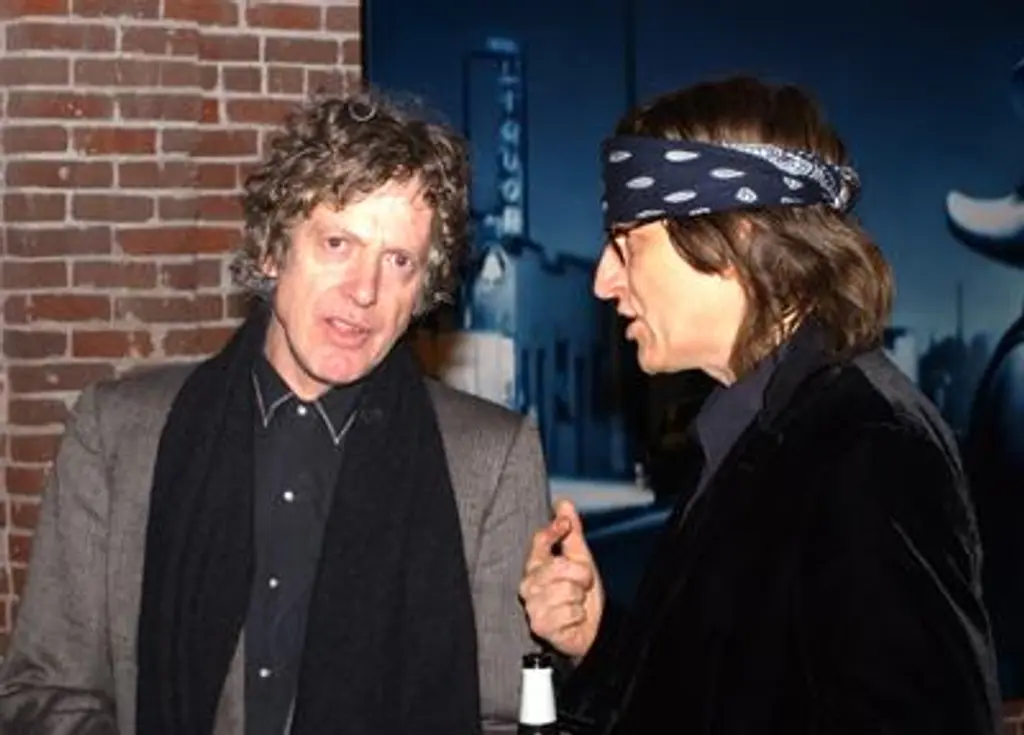
Downtown, Los Angeles, March, 30. 2004
Gottfried Helnwein:
The first works I saw of yours were the movie-theater paintings, and I remember your essay about them: "Memories of the Savoy.” It reminded me a lot of my own childhood. That contrast between this fantastic world of wonders and miracles on the screen, and the bleak and poor world we lived in.I think Austria after the War and Ireland were in many ways similar - both small and poor countries, so heavily dominatad by the Roman Catholic Church.
Patrick Morrison:
Yeah. Well, I suppose it was the realization that another world existed – this kind of mythic world from the future – and I suppose it also coincided with rock and roll and the culture in general. The cinema was like the cathedral of American culture, in a way. It was a kind of mythology that we grew up with. It wasn’t ancient mythology. It was almost like a mythology from the future world that was starting to inundate Europe. The goddesses and the gods of the cinema, and the heroes and the villains and evil, the gangsters and the sexpots – the whole America.
Helnwein:
And then there was also Rock 'n' roll.
Morrison
Yeah. All of a sudden it was Elvis.I heard him on the radio one day. We all came home from school and had lunch, which was essentially our dinner, and we would all listen to the radio. There was a show that actually continued until recently called The Kennedy’s of Castle Ross. The whole country would listen to it, and one day it hit. I came home and it was Don’t Be Cruel – Elvis.I remember going over to a cousin’s place. We used to go there every Christmas on Boxing Day. This cousin was really hip. In fact, he was a painter as well.The first time I smelled oil paint was in their little, dark kitchen. It was fascinating. But upstairs in the parlor they had a gramophone. I remember hearing Little Richard for the first time. I just played it over and over and over. I must have played it for hours. I couldn’t believe it. It was so amazing. I don’t know how we’re going to get from this to talking about painting, but I think that there is something within us—our response to that.
Helnwein:
Right. This new culture had such a fundamental influence on our generation.
Marrison:
Definitely, yeah. I suppose it’s that kind of primitive energy or something.But I always think of the movies, as regards painting. Especially when I came to America. Edward Hopper’s paintings are very small in a sense, but they have incredible scope – and the space. I’m thinking of one in particular – that motel painting. The Western Motel, or something like that, where there is a very enormous window and you’re looking out onto a Western mesa or something like that. The woman is sitting on the bed. And that kind of color as well – that early kind of Technicolor, like James Dean in Rebel Without A Cause. That final scene where he was laying dead…which was inspired by Manet’s Dead Toreador.I know that my friend Wim [Wenders] was very inspired by painting, and especially by Edward Hopper’s paintings. I guess there’s a sense of space and looking at the west.
Helnwein:
How old were you when you came here?
Morrison:
I was nineteen when I came to America.
Helnwein:
You were a painter already when you came?
Morrison:
Yeah, I was. Definitely. I had been painting. I hadn’t committed myself to painting yet. I was in the Bay Area. This was at the height of the Bay Area figurative painting. I had actually been to New York and I saw this big Matisse exhibition at the Museum of Modern Art.
Helnwein:
What were the first paintings that had an enduring impact on you?
Morrison:
When I went to the National Gallery for the first time, I was about 15 years old. I had never been to a museum before. And, I have a distinct recollection of everything I saw and the effect it had on me. I saw Veronese’s Allegories of Love, and all the great Titians and Tintorettos. Cézanne’s Bathers was already shimmering and shaking. Before I even entered the room, it felt like it was going full tilt. It’s never stopped since. It has a permanent charge.
Helnwein:
Yeah.
Morrison:
When I look at Titian or I look at Cézanne, I feel I have gone deeper and deeper into that world. I haven’t moved away. It’s not a linear thing. And I think you perceive life as a painter – even driving around LA. In a sense, it’s what makes life tolerable to me. All the torments of modern living become tolerable because you’re distracted by the wonderful visual nature of them.
Helnwein:
Right.
Morrison:
And maybe that’s a kind of a function of art. I don’t know. To make life more tolerable. Just the visual sensation. I know art works like that.
Helnwein:
I think any so-called reality has many possibilities – many layers. No matter how bad or painful something might seem, it always has also an aesthetic dimension.And I think artists have the ability to see that, whereas most people are not aware of that potential quality. They usually experience mainly the painful side of life.However, art, painting, music or writing, offer the possibility to transcend the misery of existence.
Morrison:
Yeah.
Helnwein:
In any catastrophy, decadence, pain or sorrow, there is such a big potential of poetic quality and aesthetics.
Morrison:
Yeah, I suppose ultimately it’s a kind of transcendence. I think I remember Yehudi Menuhin’s sister survived Auschwitz, and she attributed it to the fact that she had Bach’s fugues in her head. She could listen to them. She could play them in her head.And I think art is in that respect. Nowadays, everything is kind of fragmented. Culture and art, even though they overlap, are separate phenomena. I think there was a time when art and ritual, religious ceremonies, music, theater—it was all one.
Helnwein:
That's right.
Morrison:
The whole thing was to lift us, and to commune with the gods. And I think that need still remains, although nowadays, it is completely fragmented. In the sixties, it seemed there was a massive attempt through music and art that even embraced the civil rights and the anti-war movements, to effect a universal change of consciousness. Max Beckman for me was the great painter of the zeitgeist of the sixties, even though the paintings were done decades before. I first became familiar with him in San Francisco, and I was struck by the way Bob Dylan’s lyrics seemed almost to depict Beckman’s world. For instance, the song Desolation Row starts: “they’re selling post cards to the hanging, they’re painting the passports brown, the beauty parlors are getting filled, the circus is in town... Here comes the blind commissioner, they got him in a trance, one hand tied to the tightrope walker, the other one’s in his pants.”
***
Helnwein:
Did Rock and Roll have a big influence on you?
Morrison:
Well, I’ve been very close to rock and roll. I’ve met a lot of rock and rollers. I see them in a strange way – almost like ancient prophets or something. Rimbaud predicted a time when poets would move the masses of humanity.I think that rock and roll is like that. There’s a Flaubert novel – it’s a little novella. I can’t remember what it’s called. It’s about John the Baptist and King Herod. There are descriptions of out in the desert, about John the Baptist preaching and moving people to a point of almost hysteria. Jesus must have been like that – the effect that he must have had upon people. I think there is something that runs through, way back down the ages that in some way connects with rock and roll. I think it probably comes through black music, through gospel music and blues, where there is that connection – that kind of ancient alchemy of the early prophets.
Helnwein:
In that sense blues would be very close to Irish music.
Morrison:
Definitely, yeah. They were talking about the same thing.It’s all codified in a sense. The main thing was to lift you up. Even though you’re talking about the most dire misfortunes, and the sorrow of having to leave your country or the sorrow of being executed by the British or whatever. It still moves you and lifts you – I don’t know what it is. And in some strange way, I think painting is very different. I think in the course of time, it has a kind of enduring effect. I know that last year, just recently, I was back in London with the kids. We went to the National Gallery and I saw all those wonderful paintings that I grew up with. They moved me more than ever.
Helnwein:
Yeah.
Morrison:
There are astonishing things at the British Museum – the bassai friezes from the Parthenon. Just incredible stuff. There is a connection. The friezes are called centaur marquis. It’s a man fighting with centaurs. Essentially it’s war, but it’s war in a mythical timeless sense.Some kind of essence of war coming into sculpture. There’s this incredible kind of contraposto, and it’s all around the room. I think there’s something about that which relates very much to music. Music is very sculptural. Rock and roll certainly is. Keith Richards twists cords around. It’s almost like Francis Bacon in the way he twists figures around.The basic thing is that the music—whether it’s Bach or whether it’s the Rolling Stones or whatever—is a kind of very visceral immediate sensation.
Helnwein:
Yeah.
Morrison:
And it hits you. I remember the first time I saw Cézanne’s Bathers in the National Galley in London. It was already oozing, shimmering, and shaking before I even entered the room. It was going full tilt when I saw it. And it didn’t stop. It’s never stopped since then. It’s that charge.
Helnwein:
Then you come back a year later and look at it and it’s still there and it’s bigger than ever. It grows.
Morrison:
I think it is a performance. It is a record of a performance that you do day to day. It’s this solitary drama that goes on from day to day.
Helnwein:
Right.
Morrison:
And that never ends. There is no end to it.
***
Morrison:
When I first came to America I sought out the great blues musicians. I saw Howling Wolf and so on. But even with the greatest, it was just these dismal little clubs late at night. Those are timeless moments when time stops still and just a few people are there, but it’s so great you wouldn’t want to be anywhere else on the planet.
Helnwein:
When you came to the United States, did you start painting right away here?
Morrison:
I did, yeah. For a few years I was really just caught up with the wild stuff in the sixties. I landed right in the middle of the scene, what was happening. The Merry Pranksters and Neal Cassady. Eventually I met everyone. Janis Joplin. Jimi Hendrix. Timothy Leary. All these people. But I did paint.
I became familiar with Beckmann and Edward Hopper. And then, of course, pop art was going full tilt at that time. I think the first English pop art show in London was very close to where I lived – at the Whitechapel Gallery.Andy Warhol loomed really large. I saw some amazing paintings that he did, some of those electric chairs. First-rate paintings. I guess it’s the phenomenon of Andy Warhol and the effect that he has on the culture at the time. I don’t think New York would be New York without Andy Warhol.That was a time when it was all kind of one in a sense – even the whole political aspect, the Viet Nam War and movies. I remember seeing Alphaville, which was a very loving parody of film noir from Jean Luc Godard. I think in some way just the interpretation of modern life of the sixties – maybe the art is what remains. This is the real history
Helnwein:
What people very often don’t realize is that without art there is no history.Whenever we think of a great time – may it be Rome, Egypt, France under Louis XIV or whatever – what do we think of? We think of works of art - architecture, music, literature, fashion, design. That's how we define a specific period. So if art did not exist, there would be no sense of history.And without art there would probably be no religion. Because if you take art out of it, – the music, the songs, the architecture, paintings and sculptures, costumes and the choreography - religion would be totaly abstract and people could not relate to it.There would be no religion, there would be no history.- When we think of the sixties, we associate this crazy art and fashion, we think of certain music and certain colors.All that.Sometimes I think maybe the sixties were the last great epoch – like you said – where all was one.
Morrison:
Yeah. I don’t think we’ve been able to deal with everything. It’s only in the course of time.
One thing that I think was really vital for me was color field painting. I remember seeing this enormous Ad Reinhardt painting in Washington. It was all red. It was orange-red, magenta-red – reds. An enormous painting. So you’re completely engulfed. Everything just kept changing. You’re kind of overwhelmed by the optical effect. And you couldn’t stop it. You could close your eyes and it would keep on going in your head. I think there were amazing discoveries around that time.
Helnwein:
The same goes for music too. Suddenly, Jimi Hendrix used instruments in a completely different way and produced sounds that had never been heard before. Painters did the same thing with combinations of colors, images and new media that had never been used in connection with art before. The development was so fast that it was impossible to be fully grasped at the time.
Morrison:
Well, there was just such extraordinary experimentation in music. And there were all kinds of cross-fertilization of dance. John Cage and Merce Cunningham and Rauschenberg. And, of course, William Burroughs.
Helnwein:
It all started at the end of the 19th and the beginning of the 20th century with Rimbaud, Kandinsky, Dada, Schiele, Schönberg, Malevich, Mayakovsky and then Duchamp and Artaud, and very important: early black music and dance from America: blues, ragtime, Jazz...But the world-wars and the collapse of civilisation through the triumph of Ideological insanity interrupted that flow for a while, and it seems in the sixties, we continued from that point on. It was, as you said the next step.
Morrison:
As far as my work goes, I would say that my whole vision, the road that I took off on starts back there in the sixties. And it’s hard to know where it goes. But of course, it’s a road without beginning or end that takes us into a timeless realm.
In a sense we look back into – it’s not really back into time. It’s back into timelessness or forward into timelessness.
Helnwein:
Right.
Morrison:
In recent years, I’ve begun to really think of Pompeiian painting, for instance, as being very modern.
Helnwein:
True.
Morrison:
They were very modern people. From two hundred B.C. until maybe two hundred A.D., amazing things were happening in Egypt, in China and India. It was a golden age. They were very modern. They were literate. They had plumbing. It was a flourishing kind of bourgeois society. They were very sophisticated. What they had on the walls was this wonderful kind of atmospheric painting. But it was ancient mythology. Nymphs and fauns. Priapus and Venus. That was the ancient world. We think of them as being ancient, but they are really not far removed from us.
* * * *
Morrison:
I think ultimately all painting is decorative in the sense that it enhances the environment. Even Goya’s black paintings are decorative. He had them installed in his house. In fact, Saturn Devouring His Child was right up above the dining table. [Laughter]. Can you imagine being at dinner with Goya, being invited over to dinner at Goya’s place?
On the other hand there is Matisse. He aspired to a peaceful painting that brings comfort. What was the title of that painting? La Luxe, Calm et La Volupte! The cathartic aspect of painting is not really the image but the way it’s painted, the sensation of the color. Poor Vincent Van Gogh! He imagined his paintings bringing warmth and hope to sailors out on a stormy sea, a sense of some kind of safe harbor. He aspired to a kind of religious art. He had in mind a triptych. The side panels would be his sunflowers, and the center panel was a woman, La Berceuse, I think she was called—this very big-breasted maternal woman. A kind of a Madonna, or an earth goddess, in the middle between the sunflowers. Last year, I was in New York and there was a Leonardo da Vinci show at the Met, which was just utterly fascinating. Da Vinci reminds me of you, Gottfried, in the sense that he presents a seamless apparition. You almost would have had to have a magnifying glass to appreciate some of these things. There was a grove of trees about postage stamp size, but when you look into it, there it is. It’s just chalk and paper - that kind of red chalk that he used. But, there it is, magically presenting itself to you. Coming out of the da Vinci show, I found myself just wandering about, almost dazed. Then I found myself in this room with all these Poussins. My God! It felt like I was in heaven or something. Because it’s a state of feeling. I think in the course of time, that feeling intensifies, and the paintings have an evermore magical presence. There is an increasing sense of emotional belonging, or something like that – in art.
Helnwein:
Great art triggers something – like a long forgotten memory. You have the feeling there is something so deeply familiar...When I saw The Night Watch of Rembrandt in the Rijchsmuseum in Amsterdam long ago, I was in a state of shock. I was completely overwhelmed. I had tears in my eyes. I was so moved, and I didn’t know why. I could not explain it.Some guys commissioned Rembrandt to paint them, photography didn’t exist yet so they had to get somebody to paint them – and why would I, hundreds of years later, care about these mediocre guys in stupid military costumes?Why would I be so touched and moved? It doesn’t make sense. I have no explanation, there is no logic reason. The depicted subject obviously doesn’t really matter. It’s probably just an excuse to paint.
Morrison:
Yeah.
Helnwein:
Van Gogh used the chair in his room. Some ugly chair. Who cares about the chair? It shows that you can take basically anything you want, and then transform it and use as an entrance into a different universe.
Morrison:
Well, Van Gogh’s chair, in his mind, there was this strong emotion. There’s his chair and there’s his pipe. I think he had a whole kind of emotional subtext to that chair. But we don’t need to know that.
Helnwein:
This emotional aspect transfers so well. I look at it and I am moved. I don’t know what his ideas were about the chair, I don’t know the story of the chair, but I look at it and I am emotionally involved.
Morrison:
Yeah.
Helnwein:
Very often people ask, how did you get this idea? Or what does that painting mean? Or things like that. I think no painter ever, if he is honest, could explain, why exactly he is painting something.When you paint , you don’t construct, concoct or fabricate something cleverly. It’s an intuitional process, isn’t it?
Morrison:
Of course. It’s your instinct. Yeah. There’s no formula.
Helnwein:
Right. And that’s what people very often don’t understand. They always want you to explain how you got to the thing – what the idea is behind the painting – and I never know what to say.Actually I don’t care. It’s just there.Van Gogh was a good example of this. He was a guy who clinically would have been described as an insane person.
Morrison:
Yeah.
Helnwein:
He was finished. He couldn’t handle and control his mind and his thinking anymore. So he turned himself into an insane asylum. He was desperate. We know that his life was falling apart, but at the same time, as a painter, he was a genius at the peak of his creation and completely intact.So it seems that the mind and thinking is not really essential in the process of creating.It’s a completely different area or level where that comes from. Van Gogh got better and better and more intense.
Morrison:
There was this incredible clarity until the end.
Helnwein:
Right. The struggle and the darkness and the anxiety that he had on this level as a human being, and not being able to handle anything practically, did not have a negative or hindering effect on his creation.
Morrison:
Yeah. Well it drove him out there. I think it was just the terrible fear. I suppose the realization that he was going to somehow lose it made him end his life. Artaud has this great essay. It’s called Van Gogh The Man: Suicided by Society. The meaning of something in a very direct way. I remember reading about some Russian stage designer who made the claim that if you could get good enough, you could put just a chair on an empty stage, and when the audience saw it, they would all just burst into tears.It’s a very mysterious thing. But it’s very real. And very direct.
Helnwein:
I think it’s more real than anything else.
Morrison:
And it is a pure instinct. That last painting of Van Gogh’s—or what people think of as his last painting—The Crows Over the Wheatfield. In every aspect, there’s this incredible clarity and realization. It’s an amazing painting. You’ve got the blue of the sky and then the yellow of the wheat. Then this incredible kind of almost bloody, deep red in the foreground. And there’s a path. But uniting it all, and it’s one of the most extraordinary uses of black, is the crows. They weave the whole thing together. And you feel the whole tumult of the universe. I think about that all the time, especially when I’m doing these garden paintings. I want the wind to be blowing through them and the sense of them being alive, the sense of time passing and the elements and the light changing and all of that.
Helnwein:
When did you decide to paint your gardens?
Morrison:
Well, I think that it’s just something that I came to. I came to a realization over the course of time that for some reason I was destined to paint gardens. [Laughter]. I’d done it. For years and years, I’ve done watercolors and pastels when I travel. When I mean a garden, I mean God’s garden. Up in the mountain meadows or by the sea, or wherever. One just happens upon things quite innocently.
Helnwein:
There was a time when you painted only urban scenes, I rermember the streets of Paris.
Morrison:
I spent some time in Paris in the early seventies. I stayed in this tiny little apartment with a friend of mine who was a composer. I was totally fascinated by this area. There was Les Halles, which is kind of the stomach of Paris. And then the next street over is the Rue St. Denis where all the prostitutes are. A friend of mine told me later there had been prostitutes on the Rue St. Denis for over a thousand years. In fact, there are buildings there that are still used, and nobody really thinks about it, for over a thousand years. Paris is quite an ancient city. And you feel that. I used to go around. I was always fascinated looking at the girls standing in doorways and everything. Wim invited me over to Paris to be in the film called Until the End of the World. I painted there. And his place, which was my studio, was right exactly where I had been in the seventies.
Helnwein:
Oh yeah?
Morrison:
I’d get up every morning before dawn and go out there. It’s just an incredible scene—all the produce coming in, all these farmers and their wagons, and then all these girls. In fact, I recognized a lot of them from having been there previously. There were still some of the same girls operating.
Helnwein:
Really?
Morrison:
Yeah, yeah. Tough old birds.In fact, there was this tiny little woman, who was almost like that strange little woman in the Balthus painting that’s drawing back the curtains, who was out there before dawn every morning sweeping the street. I recognized her from years before and I did a little sketch. I’d go out on the streets and I’d do little sketches and then I’d go back. At the time, I was really turned onto ancient Indian sacred erotic art – The Kama Sutra – those amazing statutes and reliefs from the temples in India. The girls reminded me of that, the way they stood. It’s like an ancient kind of configuration. In a sense, it speaks to you in a strange way. You see things that have some kind of a resonance that summons up a certain kind of feeling. And then you paint it. You go back all excited with your little sketches.
Helnwein:
That’s a painting that made a deep impression on me. I never forgot it.
Morrison:
I think the first time you came to visit...
Helnwein:
Like you said, that street scene reminds me of Balthus. Your style of painting is very different, but in a way it’s describing a similar universe.
Morrison:
Oh yeah. Well, it’s the same place. When you’re there, you can’t help but think of painters. I think of Balthus. But also I think of writers—Emile Zola. He depicted all these streets.
Helnwein:
It’s a timeless magic quality. I know that in certain places you’ll suddenly feel as though there is no time barrier. You connect up to the people who created, loved and suffered there at earlier times. You can still feel them when you walk the streets. For me, their presence can be as real as if they were physically there right now. You feel connected and touched whether you want to or not. They’re there. They’re present.That’s probably the great fascination of mythological cities like Paris.
Morrison:
Oh yeah. And it’s not just the eighteenth century or the nineteenth century. It’s ancient Paris. I had the sensation – it was late at night, and I was as high as a kite probably, sort of drunk and just looking at all the people. To me, it was like they were marching through time, down the ages, all these faces. They’re the same people that walked through these streets a thousand years ago. And I think it’s something that maybe here in America we don’t really appreciate – that sense of continuity. I think we’re maybe starting to appreciate it.
Helnwein:
It’s a shorter time frame.
Morrison:
It is.
Helnwein:
That’s why it’s interesting to look at your American or L.A. paintings as opposed to the Paris paintings. It’s obviously a different universe. How is it different for you, painting in here as opposed to Paris, for example? Because in Paris, as you said, you cannot help but be connected to this ongoing thousand years of history that’s still continuing. But here you don’t have that.
Helnwein:
That’s probably why it seems much older than it really is. Because in this very short time, barely a hundred years, so many stories and fairy tales have been invented and told here. So many worlds and myths created that, in a way, you feel it is also an ancient place.
Helnwein:
That’s right. In actual time it’s a very short period. But for all of us it’s history.
Morrison:
That’s something about your work I think.
Helnwein:
I think that at different times we had different centers for the spirtual and the magic in the world. Once it was Luxor, Athens, Delphi, then Rome, later Paris and so on. You always have these places.In the twentieth century, it really was Hollywood.The way we imagine, think and dream is deeply inspired, and influenced by it.But it's interesting that people actually think, generally speaking, not very highly of L.A. it's concidered the capital for cheap and stupid entertainment - not art.
Morrison:
All of it’s superficial, kind of flashy.
Helnwein:
But that misses the point. I think L.A. is really a mythical place. It’s amazing how it changed the way the whole world – not only the Western world – sees reality. It transformed reality.
Morrison:
Yeah. Well, there’s a whole new kind of horizon. There’s a new frontier.But it’s also spiritual and kind of a psychic frontier.
Helnwein:
It seems nobody took this little desert town seriously. Nobody tried to limit or stop anything and dreaming was still legal here.Maybe that's why all this creative people ended up here.In Germany in the twenties and thirties there were great filmmakers like Fritz Lange and others, but the Nazis took over and in their empire there was no place for art.I think rulers are always worried by artists and their creations. They sense that art is a potential danger to their power.I think dictators understand more than any others, how powerful and dangerous art can be. That’s why Stalin – the most powerful man on earth at his time – was so scared by poets.He had a problem for example with a woman named Akhmatova, who wrote little poems.The guy had ten million soldiers and the biggest and most sophisticated network of secret police. But he was scared by painters and poets and and he took personally care that their works could not be exhibited, their books could not be printed and their plays could not be performed, and that artist went to Gulags or commited suicide.The same with Hitler. Modern Art put him in a rage - he completely freaked out. He burned mountains of books, he looted the museums and destroyed thousands of paintings, especially the paintings we’re talking about.And he created the so-called "Reichskulturkammer" a goverment office, that had the power to decide if somebody was allowed to paint or write. Whithout the document that gave you the permission to do so, creating was illegal.He invented the term “degenerate art”. And what he meant was art – because everything that he described as “degenerate art" was just art.
Morrison:
Yes, well, it was the most vital art. The most exciting art.
Helnwein:
Sometimes I get asked: “Do you really think art can change anything?”People often underestimate the power of art and think it's just decoration or investment for the rich.But dictators know of the potential of art.
Morrison:
The power of an image.
Helnwein:
Or the power of a tune. I think Queen Elisabeth said once something like: “If we really want to defeat the Irish, we would have to break their harps”.So I think when Germany really came down hard on its artists and stopped the creation, they had to leave. And where could they go? They ended up here in California in the middle of the desert where it was safe.That’s where Fritz Lange came and Marlene Dietrich and this boy from Vienna named Samuel Wilder who later became Billy Wilder, and Max Beckmann, Bert Brecht, Max Reinhard, Fred Zinnemann, Otto Preminger, Walter Gropius, Thomas Mann and so many others that had to leave Germany.
Morrison:
When I first came to L.A., I really wanted to paint L.A. – swimming pools and everything. You see them when you’re flying in. It’s kind of exciting. I lived out in the Valley. For a couple of years, I lived out near Topanga. I started painting from the model out there. In the neighbor’s swimming pool I spent this kind of idyllic summer painting this girl in the water. At the time, it was just the excitement of, in real life, that kind of mythic color that you’d seen in the movies – that color of the swimming pool. That amazing kind of bright – what is the color? A kind of aquamarine or whatever it is. And then the suntanned, orange beautiful flesh and the sun and flowers and the whole thing. I didn’t think too much about it. The swimming pool in a way is almost Baconesque in it being a kind of a configuration, a kind of a geometric, almost like a stage, something that delineates space. And to put the figure in is very exciting. Recently I’ve been doing these gardens. I began to think, well, I want to work the figure back into it. I began to think of the gardens. I’m painting gardens; I’m painting flowers and so forth. But when you’re out there everyday, you begin to think of the gardens in some kind of mythological sense. The hanging gardens of Babylon. The Garden of Eden. The garden of earthly delight. Hassan Issaba in the garden of earthly delight sending out his assassins. But also kind of ancient mythology like Diana the Huntress, Diana and Action. Action seeing Diana bathing, gazing upon her beautiful flesh and all that, and the terrible consequences of it. And I started thinking in some kind of mythological kind of subtext. I think it’s always there with a painter. You might be just simply there painting a figure and it might be just simply that. But somehow, subconsciously or consciously, it seeps into one’s consciousness, seeps up eventually – some kind of mythological underpinning or subtext that inspires you. It gives it a meaning. So it becomes like a pictogram. Something that tells a story.
Morrison:
It’s the same story. The figure in nature. But it could be like babes in the woods. Hansel and Gretel. Or it could be Venus. Or it could be the Blessed Virgin appearing at Lourdes.
Helnwein:
Everything is so tempting. She is tempting, but so are the flowers.
Morrison:
Ulysses looking at the sirens, tied to the mast. It’s kind of dangerous and it’s intimate. But it’s primordial and it goes way back into the depths of one’s youth as well.Actually it’s kind of funny. I think I’ve told you this before. I found your painting of Leda and the Swan, Donald Duck, amused me. But at the same time, Donald Duck could be an incarnation of Zeus. And I thought to myself, well, a coconut tree or a giant bird of paradise could be an incarnation of Zeus.
Helnwein:
In old mythology a god could turn into a tree or a swan or anything. We didn’t have these limitations and fixed distinctions of species then.
Morrison:
God resided everywhere.Even in rocks. Growing up in Ireland, ancient mythology and Catholicism and even modern Irish history all become one in a sense.
Helnwein:
It all started with a pantheistic vision.Later religions and philosophies tried to get rid of that concept,- but I think as an artist you always end up going back to that. You can’t help it.Through art you realize and experience that everything is alive, anything at all - Even so-called dead things.
Morrison:
It’s within you. And there are certain moments when you feel it. It rises up from within your consciousness.
Helnwein:
That’s what I feel with your gardens - that every flower and every tree has a personality, and in every bush there lurks some god or demon.
More thoughts on art: