July 9th, 2004
Robert Schumann Festival 2004
"Paradise and the Peri", oratorio by Robert Schumann based on Thomas Moore's "Lalla Rookh"
Thomas Moore
Helnwein creates multi-media-installation for the Schumann-festival 2004
Das Paradies und die Peri Stage, light, video and costumes: Gottfried Helnwein Thomas Moore, Lalla Rookh: An Oriental Romance Thomas Moore (1779–1852) has a permanent place in literary history as the friend and biographer of Byron and as the preeminent "Irish melodist" (after his Irish Melodies, which went through scores of editions beginning in 1807). He was a best-selling author for most of his career, rivaling and sometimes outdistancing Byron in this respect. His major venture in Romantic Orientalism, Lalla Rookh (1817), earned him £3,000 from Longman even before it was well under way, at that time the largest sum ever offered for a single poem. It was a sound investment for the publisher, going through more than twenty editions during the author's lifetime.

Das Paradies und die Peri

Multi-media-installationStage, light, video and costumes: Gottfried HelnweinRobert-Schumann-Festival, 09. July 2004Tonhalle DüsseldorfDirector, Choreography: Gregor Seyffert & Compagnie BerlinConductor: John FioreSopran: Jörg WaschinskiDüsseldorfer SymphonikerChor des Städtischen Musikvereins Düsseldorf

Video:

Conception, Director: Gottfried HelnweinCamera: Robert BrinkmannChoreography: Gregor SeyffertProduction Supervisor: Alexander PanovProduction Assistent: Cyril HelnweinImages: Das Paradies und die Peri
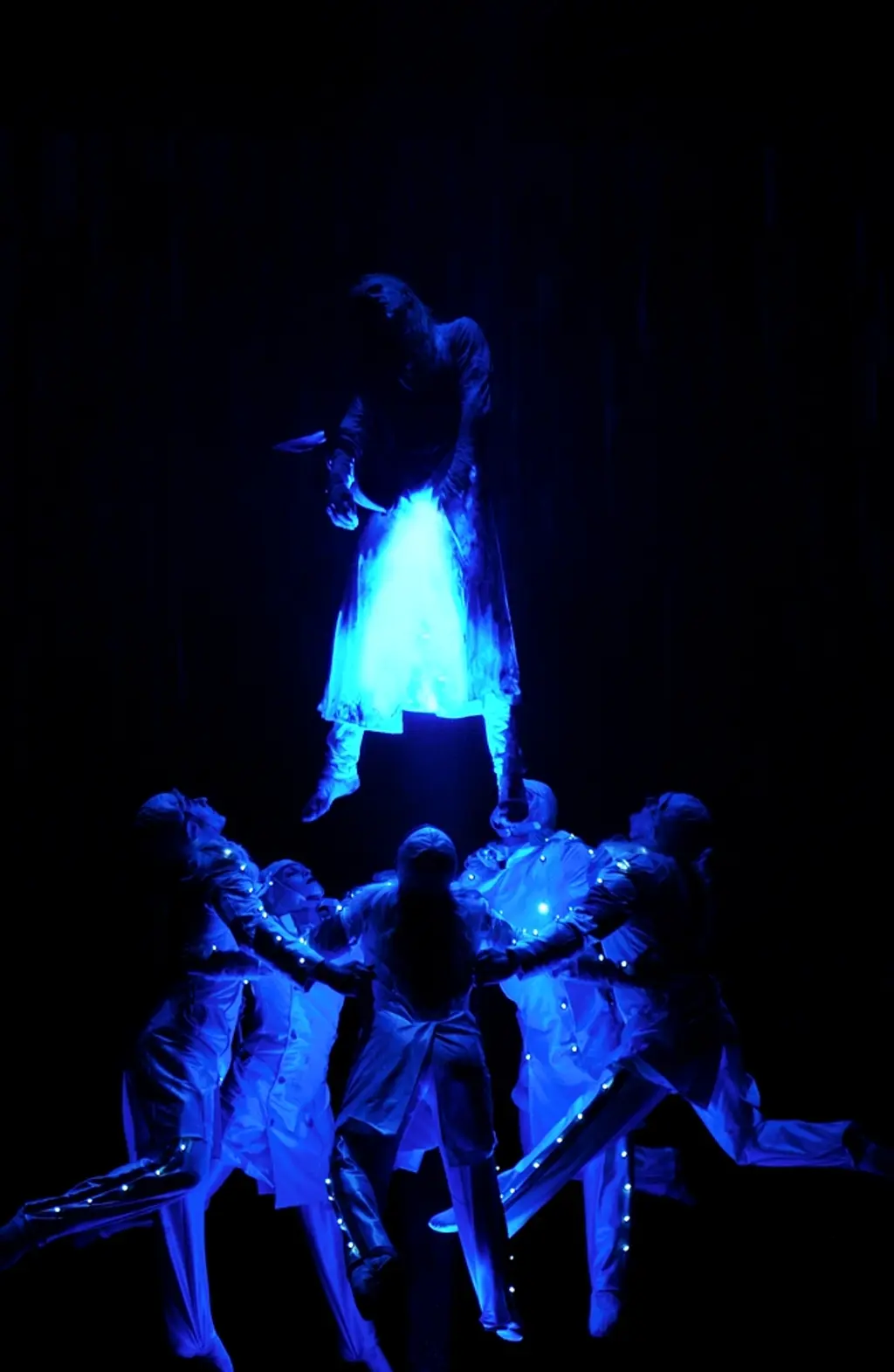
Das Paradies und die Peri

THOMAS MOORE

(1779 - 1852) poet

In 1799 he entered the Middle Temple in London to study law. From an early age he had shown a talent for singing, acting, and versifying, and he was an immediate social success in London. In 1800 he published Odes of Anacreon, which received high praise. The pseudonymous Poetical Works of the Late Thomas Little was less successful in 1801.In 1803 he was appointed registrar of the Admiralty Prize Court in Bermuda, but the seclusion of the islands was little to his taste, and he soon appointed a deputy and returned to London, visiting the United States and Canada en route. Resuming his career as a poet and socialite, he published Odes, Epistles and Other Poems in 1806 and the following year undertook his Irish Melodies, which were published in parts between 1807 and 1834, with music arranged by Sir John Stevenson from 'traditional' Irish tunes. The Melodies earned him a considerable income, and he was accepted as the national lyric poet of Ireland. In 1812 Longman offered him £3,000 to write an 'oriental romance'. The result, Lalla Rookh, was received very favourably.In 1818 it was discovered that his deputy at Bermuda had absconded, leaving Moore responsible for debts of some £6,000, and he was obliged to live abroad for three years to avoid the debtors' prison. In Italy he renewed a friendship with Byron, who left him his 'Memoirs'. Moore sold them to the publisher John Murray but repurchased and then burnt then, writing a life of Byron himself instead.He returned to his country home, Sloperton Cottage, Wiltshire,in 1822 and spent the rest of his life there. His other writings include formal satires, lighter prose pieces such as The Fudge Family in Paris (1818), and a poor History of Ireland (1827), but he is now remembered chiefly for his Melodies and for his burning of Byron's memoirs.He received a civil list pension of £300 a year in 1835. His last years were clouded by the loss of his two sons and by mental illness. Died at Sloperton Cottage, 25 February 1852; buried in Bromham churchyard.

Source: A Dictionary of Irish Biography, Henry Boylan (ed.), Gill & Macmillan, Dublin, 1998.  
 

The Romantic Period

Romantic Orientalism; Text and Contextsfrom the Norton Anthology of English Literature
Thomas Moore (1779–1852) has a permanent place in literary history as the friend and biographer of Byron and as the preeminent "Irish melodist" (after his Irish Melodies, which went through scores of editions beginning in 1807). He was a best-selling author for most of his career, rivaling and sometimes outdistancing Byron in this respect. His major venture in Romantic Orientalism, Lalla Rookh (1817), earned him £3,000 from Longman even before it was well under way, at that time the largest sum ever offered for a single poem. It was a sound investment for the publisher, going through more than twenty editions during the author's lifetime.
The work consists of four highly imaginative tales told by a young Cashmerian poet named Feramorz, employed to entertain the Indian princess Lalla Rookh on her travels from Delhi to Cashmere to be married to the king of Bucharia (Bukhara, in what is now Uzbekistan). The tales are high melodrama, with roles that could have been played by Rudolph Valentino and Agnes Ayres in early motion pictures like The Sheik. The frame of these stories, by contrast, becomes increasingly interesting as the emissary Fadladeen, one of Lalla Rookh's entourage on the journey, assumes the role of ill-tempered critic of Feramorz's tales in the manner of the Tory critics of Blackwood's and the Edinburgh Review (this was the year before they lambasted young Keats for the faults of Endymion) and as Lalla Rookh falls in love with the poet Feramorz, who at the end turns out to be the very king of Bucharia to whom she is betrothed. — The extract given here, three hundred lines from near the beginning of the third tale, "The Fire-Worshippers," establishes the principal characters of a kind of Romeo-and-Juliet plot of young (and ultimately tragic) love in a context of warring families and cultures. Hafed, the leader of the Persian Ghebers, falls in love with Hinda, daughter of his enemy, the Moslem emir al Hassan. "The overtones are unmistakably those of Irish rebellion, particularly the Robert Emmet episode," writes Howard Mumford Jones, in a still-useful biography of Moore published more than six decades ago (The Harp That Once — A Chronicle of the Life of Thomas Moore, 1937). "Moore hymns the doomed patriots and goes out of his way to excoriate the wretch who betrayed their cause. . . . [T]he suggestion that Hafed is a Persian Robert Emmet, Hinda the unfortunate Sarah Curran, and the traitor a composite portrait of government spies, is irresistible."
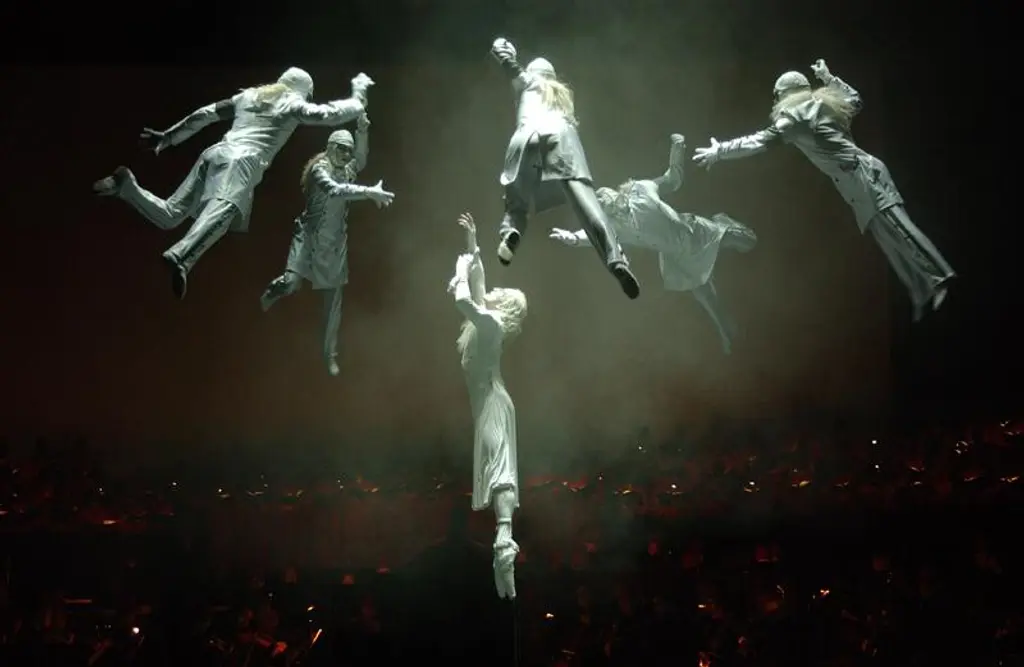
Das Paradies und die Peri
Scene from the video