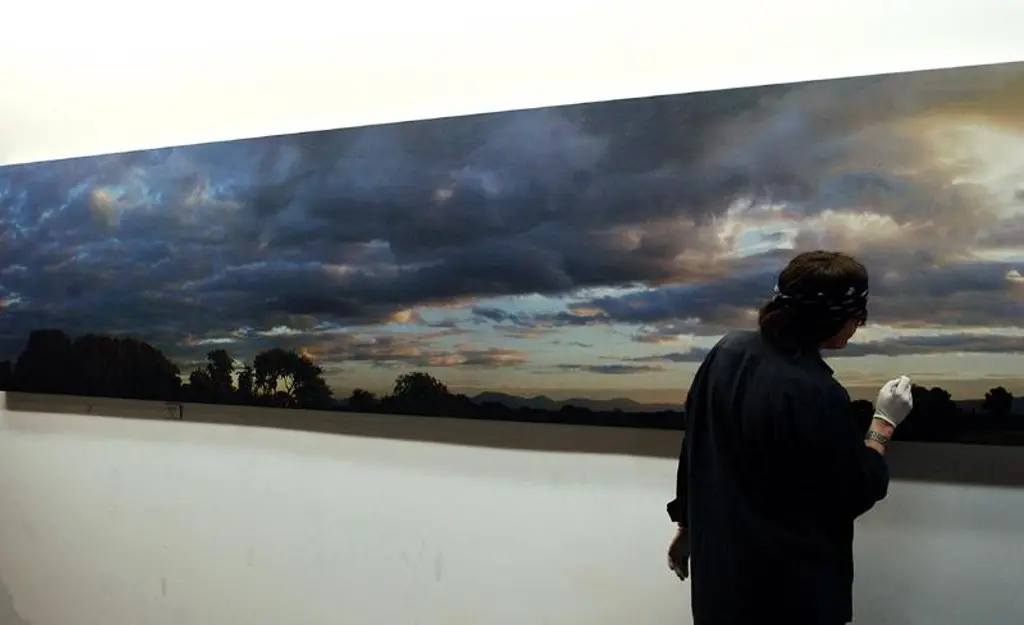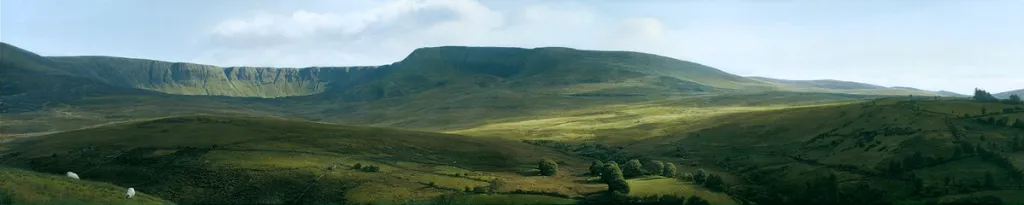
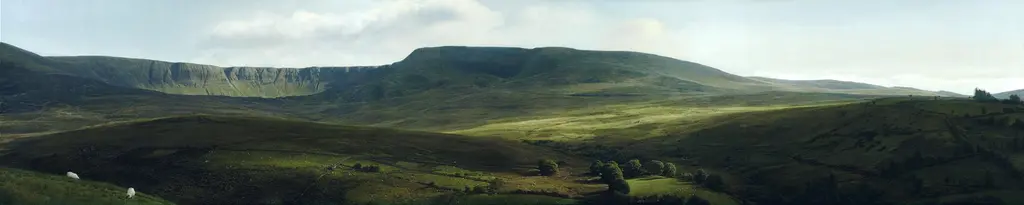
Helnwein is no stranger to controversy but while debate has usually focused on his subject matter rather than his technique, this time round the question on everyone’s lips is: how did he do it? How has he created photo-realist landscapes of such magnificent scale? The answer is that he uses digital photographs as the starting point, manipulating and magnifying them into a montage, which he then prints onto the canvas before he paints. This flawless melding of old-master skills with modern reproduction techniques has resulted in a series of highly seductive, ambitiously large landscape works.
Debate among visitors to the Crawford has been fuelled by the gallery’s labelling of works as “oil and acrylic on canvas” when they would be more properly described as mixed media on canvas. This misleading captioning aside, it is easy to see why the question of technique is foremost in viewers’ minds.
Up close to Irish Landscape I (Nire Valley) the dabbing of paint is almost impressionist in places; in Irish Landscape II (Kiltinane) black lines in the foreground effect a cartoonish leafiness — but step back, and all are photo-realistically flawless from afar.
The clue, for those determined to figure it out, lies in the varying gloss or matt-ness of the finished surface, but even up close it can be hard to tell which bits have been painted and where the occasional section of photograph peeps through.
Perhaps it shouldn’t matter, but the discovery of how they were created inevitably affects one’s reaction to the work. Despite his obvious skills as a painter, the initial dazzle of Helnwein’s technique fades slightly with the knowledge that he begins with a photograph.
It’s not easy to remain disillusioned however; these landscapes are undeniably attractive, awe-inspiring, compelling even. They work their magic through scale, vision and painterly skill, regardless of their digital origins.
The resulting show is a purely visual experience. Those searching for deep meaning and message can look elsewhere: the superficial attraction of these works is their calling card. For a man who has spent nearly 40 years making politically provocative art, this move into pure aesthetics is an odd one.
Those familiar with Helnwein and his photo-painting technique might remember his contribution to the Kilkenny Arts Festival three years ago when someone set fire to a large-scale portrait of a local girl, and red paint was daubed on one of Helnwein’s Nazi-propaganda-inspired compositions.
Helnwein is no stranger to controversy. Far from seductive landscapes, his subject matter usually veers dangerously close to the offensive. He has made a career out of art that comments on his home country’s complicity with Nazism.
The damaged Kilkenny portrait was one of a series that recalled Helnwein’s 1998 Kristallnacht commemoration show in Cologne. Entitled Selektion, that show’s anti-Nazi sentiment prompted one viewer to take a knife and slash the throats of each 12ft-high image of a child.
With works such as these, appreciation of his technical skills has generally taken a back seat to discussions on his subject matter and analysis of meaning. Helnwein’s landscapes, on the other hand, defiantly deflect any attempt at in-depth analysis.
It is possible to read them as a kind of geographical autobiography, a record of the environments that have surrounded the artist over the past few years. Beginning with a view of Vienna’s rooftops, he takes us from San Francisco Harbour to Death Valley and on to Ireland, with panoramas clearly inspired by the landscape around the Tipperary castle he bought in 1997.
Deliberately depopulated, they contain one or two telling man-made intrusions: the occasional telegraph pole, or a puff of smoke from a hidden factory.
These readings may offer fleeting diversion from the visual feast on display, but in the end they add up to little more than a determined attempt to find a layer of significance that is not really there. This is one occasion when it really is all about the surface of the canvas. It is almost as if Helnwein has gone out of his way not to make any kind of point, political or otherwise.
If past appreciation of his work has valued message over medium, with the landscapes he is making it clear: in this case the medium really is the message.
For Helnwein, photography is simply another medium at the artist’s disposal. In the past he has used our instinctive reaction to photo-realist works to his advantage, pointing out that a painting which looks photographic has more suggestive power than one that does not, simply because we are pre-disposed to take it as truth.
With the landscapes he turns that on its head. These are skilfully rendered depictions of reality and yet we cannot quite believe in them as art works because they are not purely paintings.
Why not just exhibit photo-montages, why bother to paint at all? The answer is that these photo-paintings appear even more real than a photograph: they are hyper-real, super-saturated depictions of the world that surrounds us, as we would like to see it. Helnwein’s landscapes offer us the world as we see it in our mind’s eye, our memories.
What is certain is that with these works Helnwein has raised the bar for artists to come with art that is groundbreaking in terms of scale, skill and vision. Painted mountains, fields and sky can never be the same again.
Gottfried Helnwein — Irish and Other Landscapes is at Crawford Municipal Art Gallery, Cork, until September 4