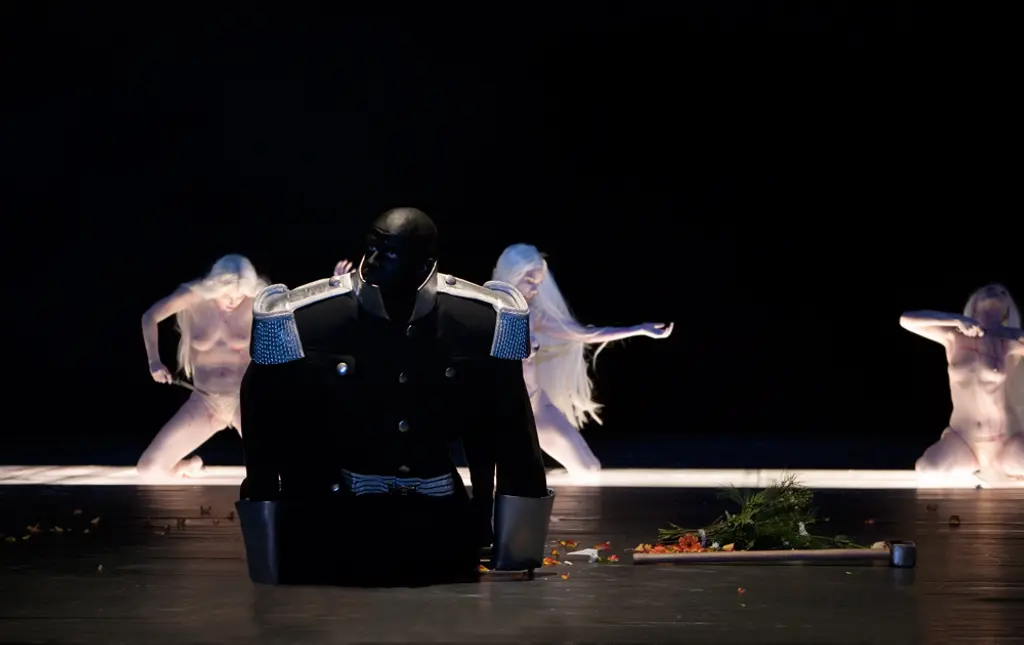
Kresnik and Helnwein's "ring," a gilded automobile tire, descends at the end of the piece. An automobile cemetary appears, dominated by a gilded Cadillac upstage. The contents of a large refrigerator, which has hung over the stage since the beginning, pour out over the scene, suggesting the products of Weimar as material for ongoing consumer culture.

Johann Kresnik has been internationally active as a choreographer and director since 1967. After working in Bremen, Heidelberg, and at the Volksbühne in Berlin, he and his ensemble were engaged at the opera in Bonn. Der Ring is Kresnik and his dancers's last production, as the ensemble has been forced to separate for financial reasons at the end of the 2007-08 season.
I will begin with a few words concerning Johann Kresnik's aesthetic approach and the content of his work. Kresnik received a traditional education in classical ballet. In the sixties he worked as a solo dancer on the stage of Cologne together with George Balanchine and John Cranko, among other things. But Kresnik was unsatisfied with the ballet which, according to his view, was mechanical and void of content, focusing upon upholding conventional aesthetics while outside students were in revolt and people were demonstrating in the streets. Inspired by the not-purely-classical choreography of Aurel Milloss or Maurice Maurice Béjart, Kresnik moved further away from classical academic dance, terminated his active career as a solo dancer, and started to choreograph his own works.
Milloss and Maurice Béjart must be mentioned when considering the work of Kresnik since both have a tendency towards theatrical effects. Their dance technique is strongly expressive and theatrically accentuated but the technique of classical academic dance is never surrendered or renounced. Their inclination toward a symbolic metaphorical language, spectacle, sentimentality, pathos, and even kitsch, as well as the desire to use shocking effects and break taboos, allows them to bring a variety of stylistic devices on stage.
In Kresnik's first piece, O SeIa Pei, created in 1967, he adapted pieces of text concerning people suffering from schizophrenia into choreography. This early piece shows typical characteristics of his work, beginning with the topic. He does not choose classical ballet material but is interested in politically and socially critical topics. Kresnik does not choose the material for his performances with based on its appropriateness for choreography. His decisions are solely based on his personal interest; on the impact of the dance on political and social development; and on his own conviction that it is important, here and now, to confront oneself with these things.
The second characteristic of his choreography is that he does not develop a dramaturgicalIy linear plot but creates instead a collage of pictures out of fragments. Thirdly, I believe, his work can be referred to, even in its early stages, as intermedia! because he uses slide-projectors and connects dance to language. In 1973 Kresnik first used the term "choreographic dance" in connection with his piece Traktate to distinguish himself from the conventional term Tanztheater ("Dance theatre"). With his "choreographic theater" he wants to create a new language of the body which he can use as means for constructing his pictures. Simply stated, he uses the classical academic dance vocabulary, supplements it with material from modern dance, and then breaks the entire thing up to create something entirely new.
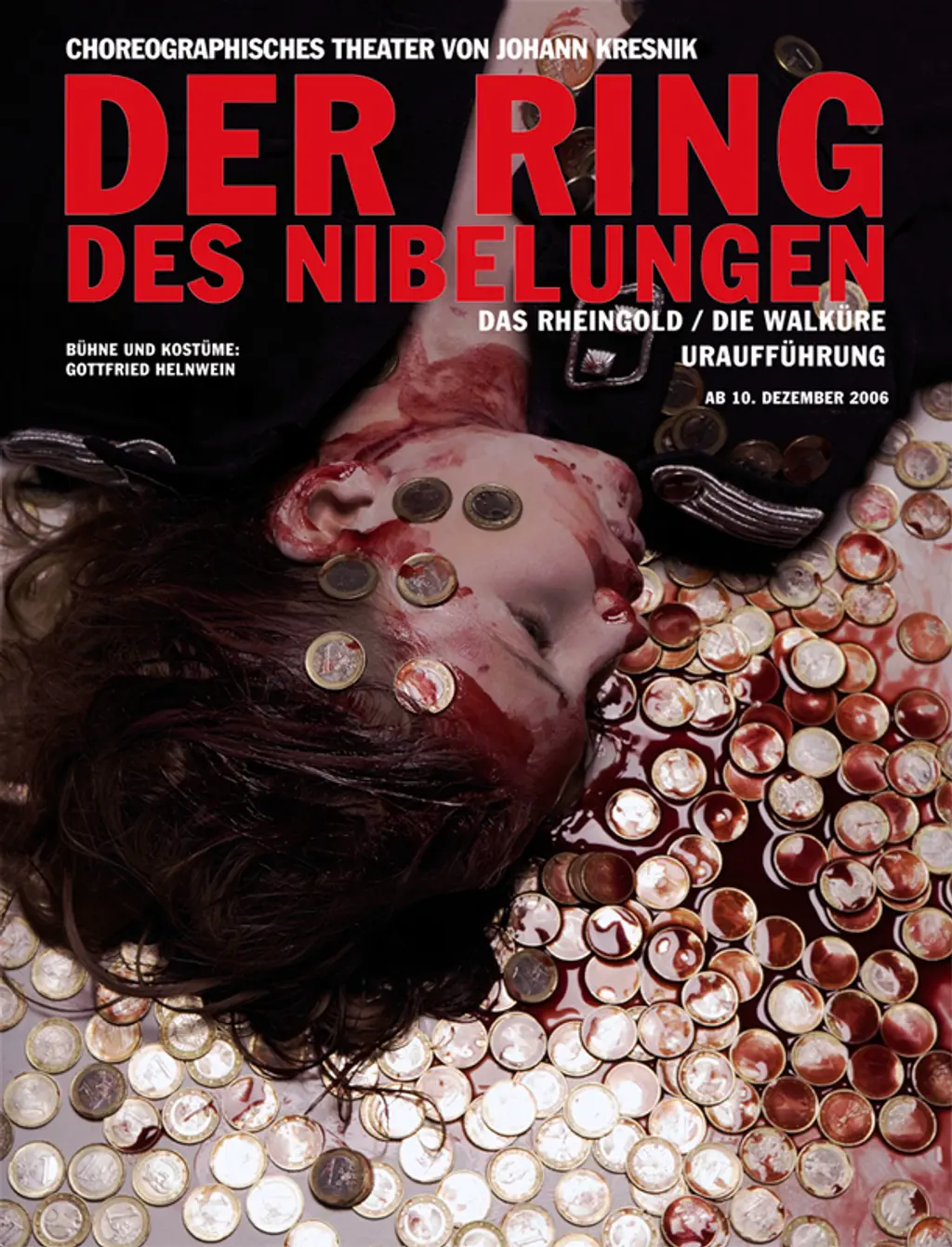
In February 2008 Kresnik presented the final production of his ensemble, based on Richard Wagner's Der Ring des Nibelungen cycle, in Berlin. Kresnik's Ring was created in collaboration with the painter and scenic designer Gottfried Helnwein, who expresses himself in his works of art just as politically as Kresnik. This is apparent with the poster to the production, which was also created by Helnwein: the head of an exhausted child lying in a pool of blood, overwhelmed by a heap of Euro coins. Kresnik and Helnwein argue on the topics power and money, force and war. The four parts of Wagner's original cycle takes about fifteen hours to perform. Kresnik's collage of Siegfried and Götterdämmerung lasts only about an hour and ten minutes. The music, arranged by Gernot Schedlberger, is also cut down. He prepares a sound carpet of Wagnerian quotations.
In this production the familiar story is not retold accurately as might be expected. Rather, Kresnik puts the story into the context of Wagner's biography and his cultural and social surroundings. This is very typical of Kresnik's work. When choosing the themes for his pieces, Kresnik dwells on the fate of an individual, as could be seen in his Sylvia Plath, Pasolini, Hannelore Kohl, and Ulrike Meinhof. In The Ring Kresnik blends biographical details with elements of the opera's original story. Contemporaries of Wagner appear, such as Ludwig II, Cosima and Winifried Wagner, and also Wagner himself. The production does not follow the chronological flow of the story but is rather a revue, a round-dance of pictures. In fact Kresnik's work can be seen as an intertextual interpretation.
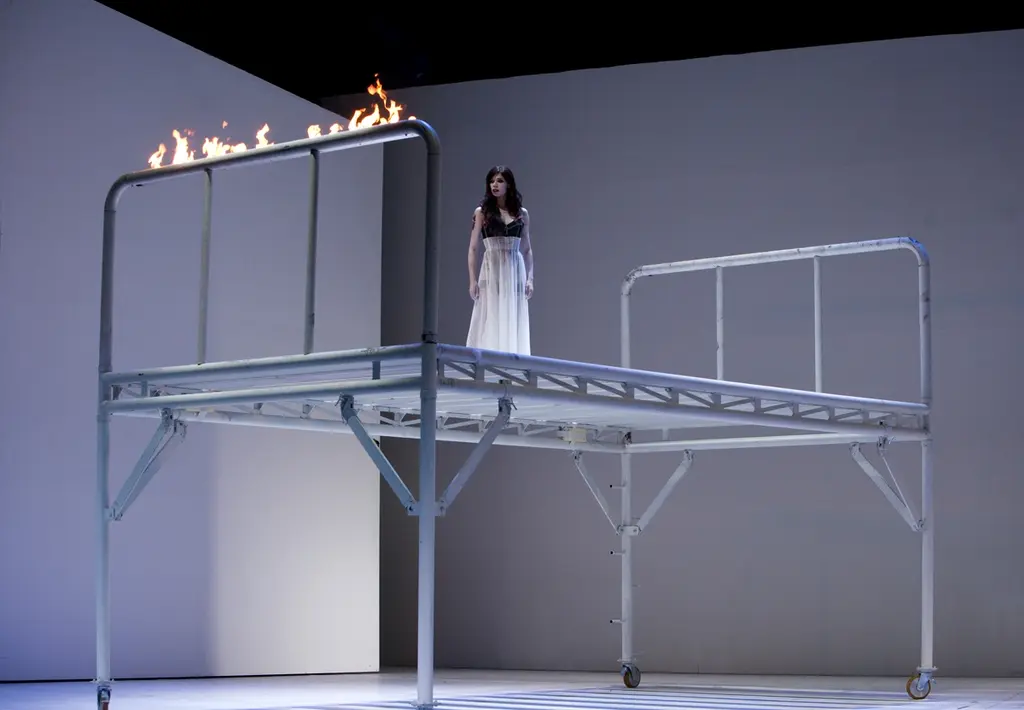
The stage and the decor play as important a role as the actual choreography in implementing Kresnik's expressive pictures and ideas. Valhalla, the castle of the gods, is represented as hospital ward with blood-smeared walls and wounded soldiers are pulled into the sky. As Kresnik has said, "I am mainly concerned about the message of the piece. The stage designer has to support the message of the piece, has to find a realization for that together with me." To support his message, Kresnik utilizes all the technical means at his disposal. Film is projected on screens and on human bodies as subtext for the scenes executed by the dancers. The prologue to Götterdämmerung, for example, concerns Wagner's anti-Semitism and the exploitation of his work by the Nazis.
The question may arise as to whether in such examples we are dealing with intermedial relations between film and theatre or multimedia theatre? If we define intermediality as the simulation or realization of one or more media conventions in another medium, the question arises as to its distinguishing characteristic. Just the use of other media (such as film, video, or slide- projection) in theatre is not a guarantee for intermediality. For this the established term multimedia theatre exists. However the boundaries are in constant flux as multimedia theatre may follow an intermedial strategy, even though this is not imperative. Thus film documents are used in the festivals in Bayreuth. One sees Hitler rising in power and welcomed by Winifried Wagner. The film clips are followed by others of Konrad Adenauer, Federal Presidents Lübke, von Weizsäcker and Rau, followed in turn by more current state appearances in Bayreuth, of figures like State Chancellor Angela Merkel.
In the Götterdämmerung prologue, Kresnik combines the medium of theatre, which is characterized by its evanescence, with a repeatable medium, a Walt Disney film from the forties, placed together to create a single image. The scene, similar to a silent film, is accompanied live by two pianos and is underlaid with tape-recorded anti-Semite quotes from Wagner. There are various possible approaches to the examination of this sequence. On the one hand we are dealing here with a film-performance situation, similar to that in a movie theatre.The projection of the Disney movie in a theatre piece, however, implies an essential differencein format. In front of the screen, center stage, the actual theatrical scene is being performed: Wagner is being "written upon" with swastikas. Thus the audience must constantly shift focus between the movie, projected on the screen, and the happenings on stage. Kresnik and Helnwein's "ring," a gilded automobile tire, descends at the end of the piece. An automobile cemetary appears, dominated by a gilded Cadillac upstage. The contents of a large refrigerator, which has hung over the stage since the beginning, pour out over the scene, suggesting the products of Weimar as material for ongoing consumer culture.
With this fascinating and disturbing work the company ends its influential and imaginative career and the stage in Germany in general and Bonn in particular is made distinctly poorer by its loss.
GENIA ENZELBERGER
studied theatre at the University of Vienna. From 2004-05 she was an assistant at the National Academy of Building Arts Stuttgart in the master class of Martin Zehetgruber. Since March 2007 she has been an assistant at the Institute of Theatre, Film, and Media Studies at the University of Vienna. During her studies she worked as assistant for several stage managers like Johann Kresnik and Martin Kuséj. As free dramatic advisor she had engagements at the Burgtheater, Thalia Theater Hamburg, Dietheater Vienna, Ensembletheater Vienna, and Hamburg Kampnagel.