Photo: Ethan Pines for The New York Times
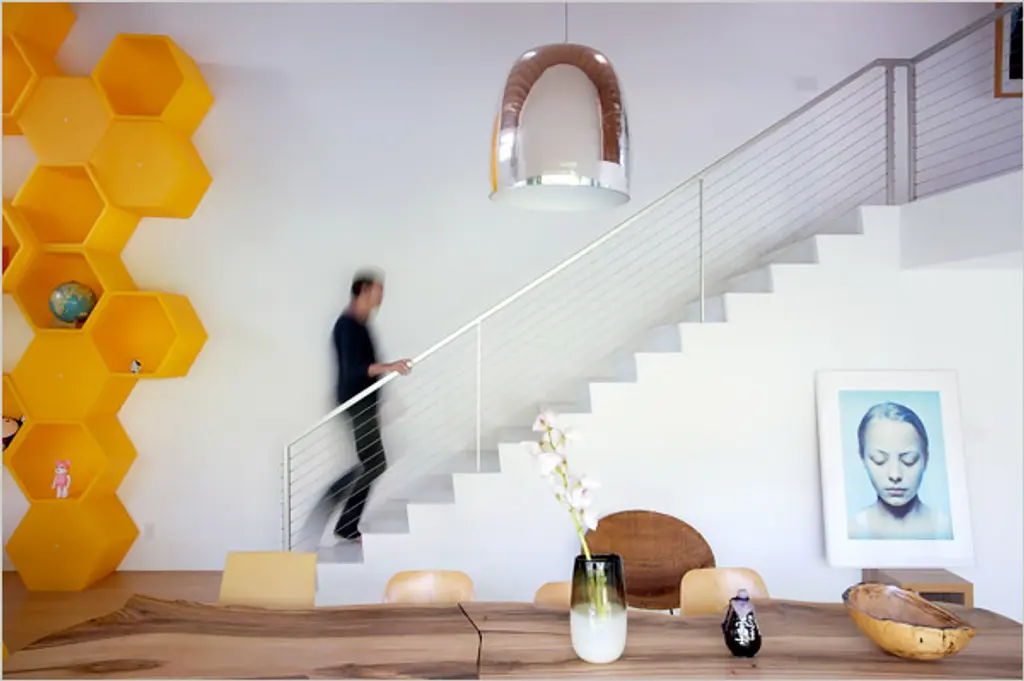
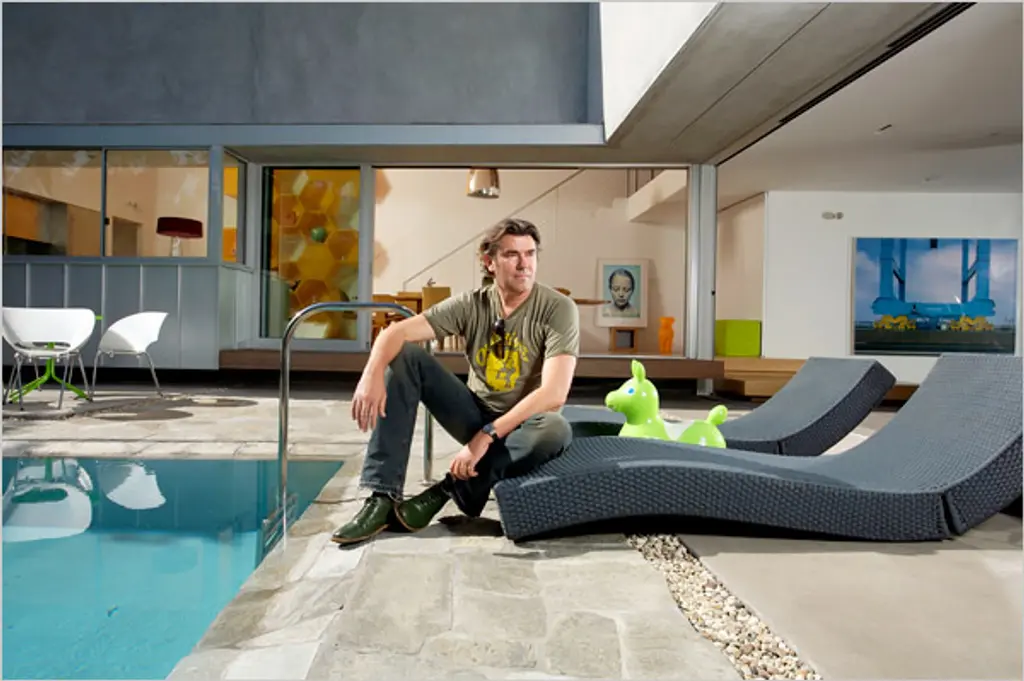
ON a searing Sunday, Clive Wilkinson was directing a melting pot of pals (or a pot of melting pals, as it were) preparing an English brunch, with a nod to South Africa, his birthplace.A strapping 6-foot-4 architect who calls everyone “Ducky,” Mr. Wilkinson had the boyish energy of a late night television host, even on the 90-degree day. Cheerily he offered his just-baked bread, sliced the cheeses, dished the quince paste and poured the youngberry juice. He nodded approvingly at a friend submerging bacon in cooking oil and teased another into whisking 20 eggs.The stage where Mr. Wilkinson played to his regular crowd — design writers, filmmakers, novelists and their children — is a new sun-filled house he designed for himself but built largely around the theme of entertaining others.Rooms slide open, to each other and to the outdoors. Guests spill out onto wooden platforms that extend from the house like floating porches, and picnic indoors at a sinuous dining table that seems to flow around them and gather them in. The house’s plan encourages the easy interaction of people as well as any bar or nightclub design.
In fact, friends call the place Club Clive.
It might also be called the House That Google Built. Mr. Wilkinson’s $15 million renovation of the company’s base in Mountain View, Calif., in 2006, with 180,000 square feet of new offices, made him a design star. The project, his first major commission since a downturn in business that followed the Internet bust and 9/11, along with other recent high-profile commissions, including Nokia and the BBC, has also helped him refine his signature approach to building for a crowd.
This house — the first one he has ever designed — is a small-scale, far more intimate expression of an architecture of togetherness that Mr. Wilkinson began working out a decade ago for advertising agencies like JWT and TBWA/Chiat/Day. In the process, it is widely agreed, he has helped reshape workplace culture, pushing it in a social, collaborative direction. “Clive creates a place where creativity happens,” said Rosemarie Ryan, president of the New York office of JWT.
Why did Mr. Wilkinson, 53, wait so long to build his own house? For most architects, taking this step is “a kind of catastrophe,” he said wryly. “They have an immense identity crisis. They think it’s a summary expression of their capability, who they are in the world.” (His own foray into this fraught territory was delayed by more than anxiety: He started sketching a house years ago, but by the time he was finished, so was his 10-year marriage.)
If designing for one was daunting, Mr. Wilkinson has excelled at building for many, in some two million square feet of workspace, restaurants and schools. A kind of Darwin of office behavior, he treats companies as giant ant farms, recolonizing inhabitants into cooperative nests rather than competitive burrows. His approach to the workplace emerged at a time of turnabout in corporate thinking that Michael D. Schrage, in his 1999 book “Serious Play,” characterized as focusing on breakthrough innovation, and the notion that it demands more than just a good strategic plan — it demands inspiring collaborations.
For his celebrated makeover of a warehouse for Chiat/Day in 1998, Mr. Wilkinson built in surprise, creating multiple places for people to cross paths and interact, with a “Main Street” of offices stacked like shipping crates and a “Central Park” for espresso — the barista update of the water cooler.Toying with — or traumatizing — the status quo, he has built walls with AstroTurf (“it looked like ivy if you didn’t look too closely,” he said) and tenting fabric. At the School of Fashion and Design Merchandising in Los Angeles, he created a “tank” conference room that was encased in blue glass and suspended on 8-foot-tall pillars, on view to students moving about.“These are not offices, they are memorable places for people to work in new ways,” said Paola Antonelli, senior curator of architecture and design at the Museum of Modern Art. She added: “Clive uses Facebook and Twitter, cooks old family recipes for his friends, and suffers no jet-lag that will stop him from a night out with his pals. The sociable nature of his projects is not just an algorithm or a rule manual, it is his very personality. “
But the Google project offered a lesson in how far innovation can be imposed. “You’re always asking, are you trying to put people in touch with some kind of fashionable notion of design?” Mr. Wilkinson said. “You can find yourself going down a deadly path.