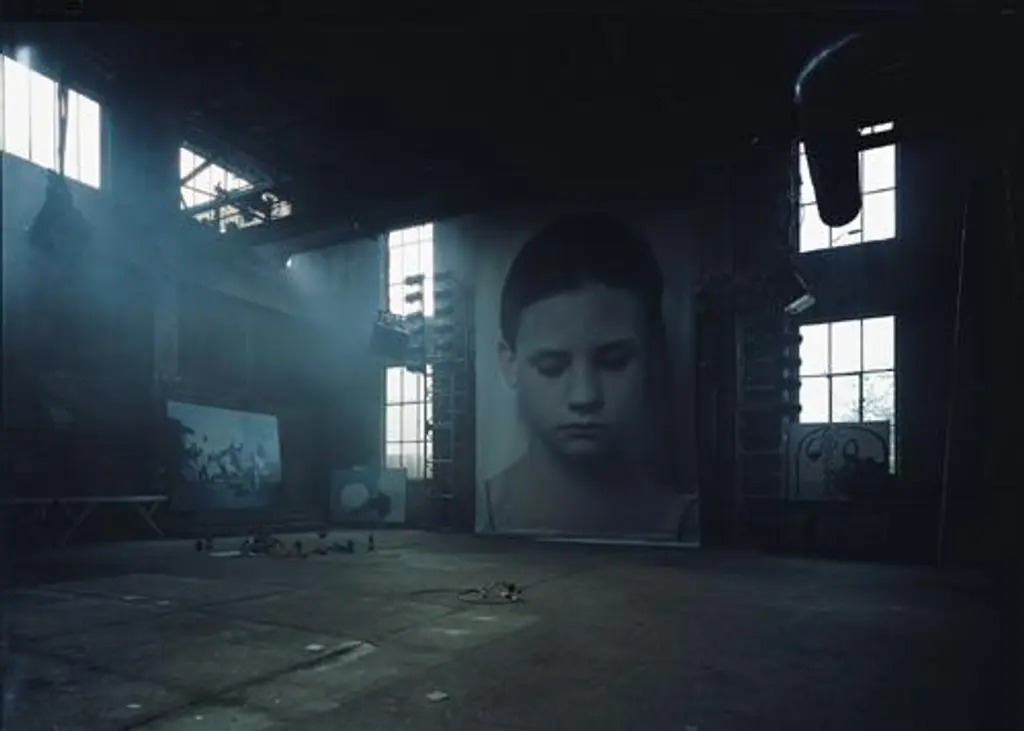
The perverse marriage between good and evil, ugly and beautiful in Helnwein's images clearly shows that despite his strange world of images he is genuinely a purveyor of humanism. In my opinion Helnwein represents the moral and political art in the right manner. The images deal with something that is important and personal to the artist and at the same time also deal with matters common to all humanity.
Speaking of morals and values is often branded as conservative, but when one focuses on a level higher, ethics, one is on the winning side. Morals are always one group's opinion of what is right or wrong, and morals tend to give strict instructions. Ethics, on the other hand, attempts to separate itself from locality and in a broader spectrum consider those mechanisms with which good and evil are defined. And Helnwein moves on a meta-level: he does not present reasons or consequences, he presents the situation and lets the spectator solve the mystery of the macabre tale -- and the solution reflects the spectator's own values.
But who is this devil hired by God? Gottfried Helnwein is an Austrian artist, who has always wanted to rebel. He was given a Catholic upbringing and resigned from the church; he went off to an art school and got fired; he made public works about Nazism in Austria (= taboo) and the works were torn. And he likes Mickey Mouse too.
In the 70s his rebellion started from the now familiar absurdity of defining high or low art; Greenbergian formalism and Puritanism are just air to him. Art must have an effect!
Besides shocking photorealistic paintings he has made images that deal with the problematics of presentation: monochromatic portraits whose colour scale is so small that the persons in the pictures are barely recognisable, and as a kind of opposite to them, ultra-accurate photographs of stars in the entertainment world.
I look at a picture of a young girl's head from the exhibition catalogue. Kindskopf (6x4m) was exhibited in the gothic church of Krems. One can't help but think of the Biblical fable: on the altar, suffering for all of us... and betrayed by somebody... although he is good and innocent... a victim... But who betrayed this little Jewish girl? Hitler? A candyman?
The world is not a good place.
Do Helnwein's images leave room for hope? (Hopefully?) The mutilated limbs, the physical and psychic violence and the uncomfortable erotic background that Helnwein depicts can only give hope through negation. And if one seeks negation from beauty or from the surface, the direction is wrong.
The world is truly not a good place to live in.