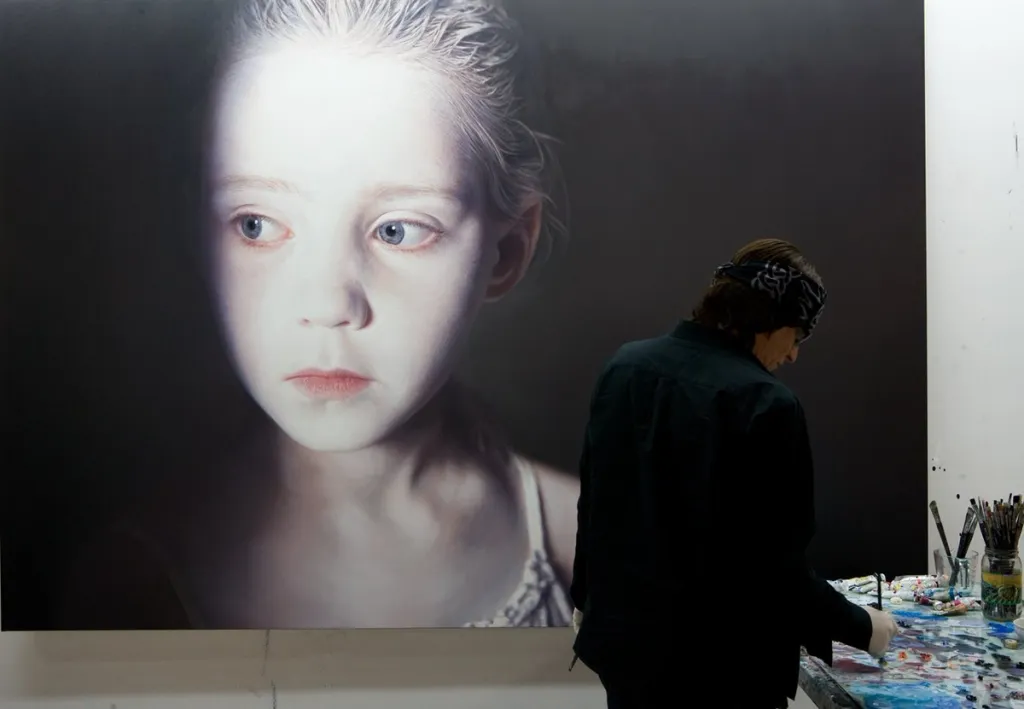
Since he began his career in Vienna in the late 1960s, Helnwein has been known for his radical use of the portrait and self-portrait. His photography, paintings, and monumental installations address themes of inhumanity, violence, and the importance of personal expression with stark and probing psychological intensity.Helnwein’s focus on the innocence and wonder of childhood idyll is exemplified in provocatively themed paintings whose forceful imagery is rooted in the artist’s upbringing in post-World War II Vienna. His was a somber childhood overshadowed by a repressed national memory, in which hope was gleaned from American culture, as represented by Mickey Mouse and Donald Duck.
As part of an emerging Austrian generation vigorously questioning the nation’s role in WWII, Helnwein developed a heightened sense of the need for truth and tolerance. In school, he discovered a persuasive form of argument in visual art. According to the artist, “you can change something with aesthetics, you can get things moving in a very subtle way, you can get even the powerful and strong to slide and totter, anything actually if you know the weak points and tap at them ever so gently by aesthetic means.”“The contradictions between the human potential for beauty, enlightenment, tremendous accomplishment, and sordid ugliness has been the ongoing topic of Helnwein’s art,” said Diana L. Daniels, associate curator at the Crocker Art Museum. “His is a voice of tolerance, empathy, and personal freedom, and his paintings make concrete for us the role that values, ethics, and faith in humanity play in fostering human happiness.”
“Gottfried Helnwein: Inferno of the Innocents” draws particular attention to the influence of Los Angeles—Helnwein’s current home—on the artist’s practice. Helnwein’s artistic voice is distinguished by the purposeful channeling of the power of cinema, as he brings the narrative style and grand scale of the silver screen to his art. Helnwein’s connection to California is also evident in works such as the panoramic mixed-media painting “American Landscape I (Death Valley),” which will be on view as part of the exhibition.A full-color catalogue, edited by and with an introduction from Diana L. Daniels, will accompany the exhibition.The catalogue will also include an essay by Mark Van Proyen, art critic and associate professor of painting and interdisciplinary studies at the San Francisco Art Institute. The catalogue will be available for purchase at the Crocker Art museum store.
Join associate curator Daniels for an intimate conversation with Gottfried Helnwein, who will discuss his artistic processes and inspirations as well as the influence of his own personal history on his work Saturday, Jan. 29, at 2 p.m. Reservations are required. Purchase tickets at crockerartmuseum.org or the admission desk. They are $10 for members and $15 for nonmembers.
The Crocker Art Museum, established in 1885, is one of the leading art institutions in Northern California. The Museum offers a diverse spectrum of special exhibitions, events and programs to augment its collections of California, European, Asian, African and Oceanic artworks. The Crocker is located at 216 O Street in Downtown Sacramento. Museum hours are 10 a.m.–7 p.m., Tuesday–Wednesday; 10 a.m.–9 p.m., Thursdays; 10 a.m.–5 p.m., Friday–Sunday. Every Third Sunday of the month is “Pay What You Wish Sunday” sponsored by Bank of America.For more information call 916-808-7000 or visit crockerartmuseum.org.
The New Crocker is now open. With four times the exhibition space and more than 2,000 new works on view, there’s a lot more to love at the Crocker so the hours have been extended. In addition to being open Friday, Saturday and Sunday from 10 a.m. until 5 p.m., the Crocker is now open from 10 am until 7 p.m. on Tuesday and Wednesday, and 10 a.m. until 9 p.m. on Thursday.