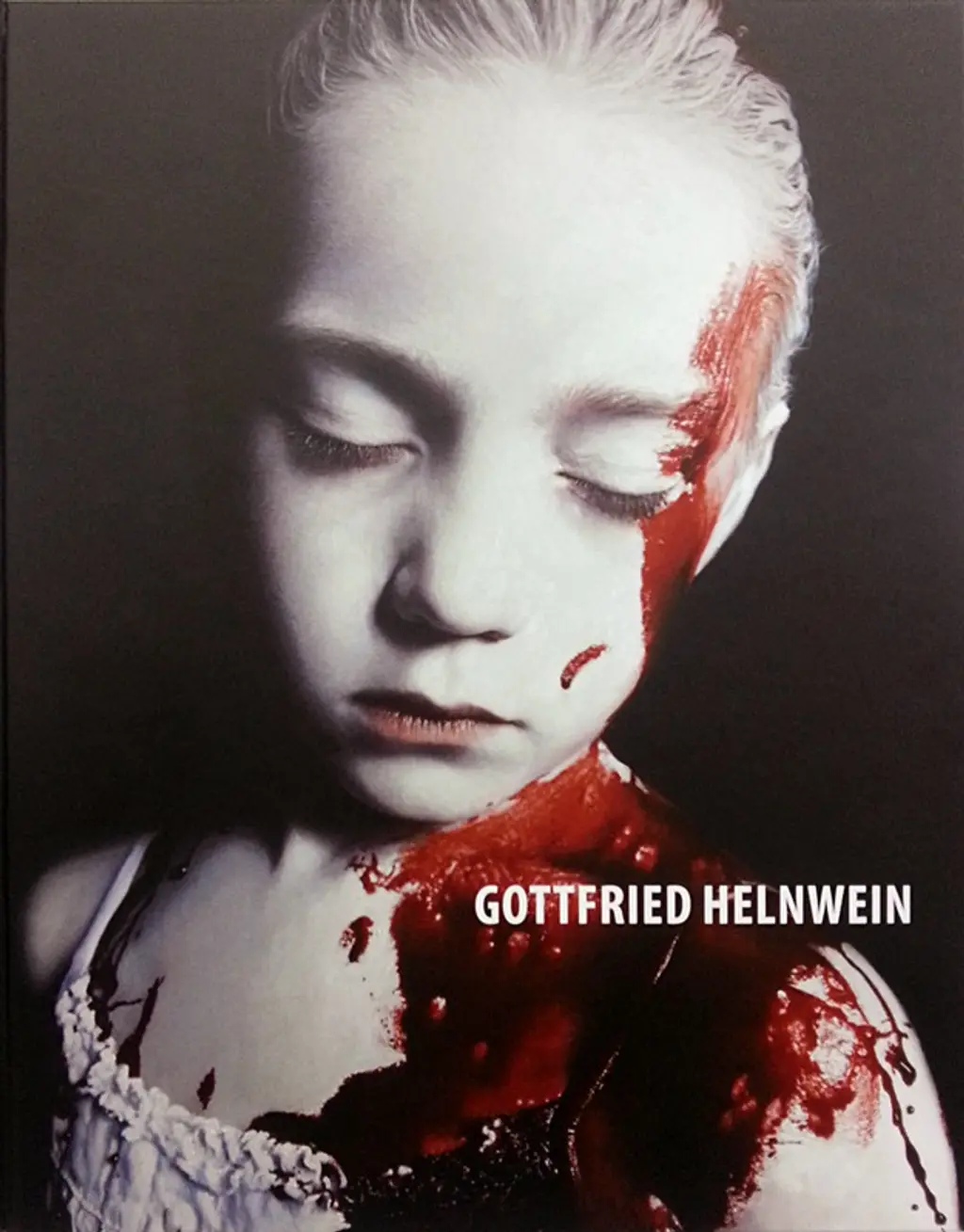
Editor’s Note: This interview was conducted by e-mail in January 2013, while Gottfried Helnwein was traveling in Europe. The interviewer, Howard N. Fox, is former curator of contemporary art at the Los Angeles County Museum of Art.
GH: Since my early childhood I was always drawing, usually scenes of disaster or war, but I never wanted to become an artist. As a kid I thought artists are people with big beards and berets standing at easels all day and painting abstract paintings. I considered that an extremely boring life. In my understanding the ideal existence as an artist was being a member of the Rolling Stones.When I was eighteen years old there was this moment when I realized that I had no place in this society, everything was under the control of some authorities, restricted and regulated , no freedom, no space to breathe. And I hated rules and authorities. And then I realized that the last sector where I could be independent and express myself freely was Art. So I decided to become an artist.
GH: The main reason why I decided to enroll at the university for Fine Arts in Vienna (Akademie der bildenden Künste Wien) was that I needed a space to paint. So I painted my first (water color) painting to get accepted for the entrance examination: a doll-like child with a white dress and an expressionless face, holding a bloody knife with an identical-looking dead and blood-soaked child spread out in front of it.To my surprise, Professor Hausner, whom I approached, seemed impressed, and he accepted me at once for his master-class without the usual examination. (This is the same university that sixty years earlier rejected a young man with the name Adolf Hitler twice. Which, of course, was the biggest mistake that any university ever made.)In the first years I painted like an autistic child. I was not interested in any art theory or traditional techniques or concepts, and I never attended any lectures. I just worked for myself, to explore the theme of the wounded child. Parallel to my watercolors and drawings I also started to photograph and I did my first performances with children – utilizing bandages and surgical instruments. My work has been a continuous process and between my first paintings at the Akademie der bildenden Künste, and my works since then are of no fundamental difference.
GH: Learning about the Holocaust for the first time in my teens had a deep impact on me. It was a turning-point for me. I became obsessed with the idea of finding out everything about injustice and abuse, war crimes, about violence and pain inflicted upon defenseless human beings, especially children. Eventually I came across some forensic photographs of children's bodies, tortured to death, often by family members. These were images I could not forget. The questions I had regarding these subjects were the main motivation for me to become an artist.
GH: In our loud and frantic adult world where children are usually marginalized or kitschified, I guess I want to force people to confront purity or innocence and the vulnerability that you can see in the face of a child, and the pain and innocence betrayed.
GH: I was always oscillating between the two mediums photography and painting and I like the irritation that it causes when I blur the distinction between these two. I think the importance of the medium and the technique used in art is overrated. The essential question is, however: is an art work capable of creating an emotional impact on the onlooker? Does it touch, move, startle, inspire, elevate, does it provoke or challenge?
GH: Vienna, the city I was born into right after the Second World War was a dreary place. The long shadows of the Third Reich were still cast over the city and the smell of death was in the air. I remember the empty streets, ruins of bombed houses, rust, rubble, no colors, no sound. There was a sense of despair. All the grown-ups I saw seemed silent, dark and broken. I never saw anybody laugh, I never heard anybody sing. It was a world that stood still, as if undecided yet if life should go on. What I didn't know then, was that my parents’ generation had recently lost two World Wars in a row and just completed the biggest genocide in history.The only art that I saw in my early childhood were 19th century paintings of tortured, blood-soaked martyrs and saints on the wall of cold churches were I spent a good time of my childhood. Until one day some PR-officers of the occupying American forces, God bless their hearts, thought it a good idea to bring some American culture, say Walt Disney's comic books, to the Nazi-kids in Germany and Austria to re-educate them. Especially the Donald Duck stories by the ingenious Disney artist Carl Barks hit us children like a comet and turned our world upside down. It was a culture shock. For me it was also an epiphany, a religious experience. Opening my first comic book was like leaving my parents’ yesterday-realm of death and darkness and stepping into a bright and infinite future. For the first time I experienced color and speed and the power of fantasy and imagination.Many European artists and writers of my generation talked about the impact Donald Duck had on their childhood, amongst them Elfriede Jelinek, Günter Grass, Peter Handke, H. C. Artmann, Theodor Adorno. And even though Donald doesn't look like a human being, but rather like a duck, he embodies the essential problems of Human Existence more than most fine artworks I have seen. It is fascinating how this small, artificial drake is such a precise mirror of the human soul.The central theme of my art is the child. Over the years I went in lots of different directions with my work but for some reason I always came back and ended up at the child again. Other elements that run through my work are pain, injury and violence, and there are also frequent references to historical and political events. But from time to time I felt the necessity to interrupt that flow and challenge these realities by interjecting comic characters as a kind of counter-reality. In the last years I have also used elements of Manga and Anime, though this aesthetics are very foreign and bewildering to me, I am fascinated how these strange creations have permeated popular culture everywhere in the last decades.
GH: When I started to paint and for the first years, I was relatively uninformed about art history and especially about contemporary art. It was a deliberate decision on my side to reject the cultural tradition of my parents’ generation and any knowledge of it and anything that was even loosely connected to the hated art lessons in school. The only exception for me was the Romanticism movement of the early nineteenth century – especially painting and literature, which at that time were considered decadent and inferior by the Art establishment. I remember a professor at the College for Graphic and Design (Höhere Grafische Bundes Lehr- und Versuchsanstalt) saying: "That's how you recognize real art – if it’s abstract, it's art, if it's realistic it's kitsch."The works of artists like Caspar David Friedrich, Novalis, E. T. A. Hoffmann, Heinrich Heine, Eichendorff, Adalbert Stifter, Oscar Wilde, E.A. Poe, the Grimm brothers, H.C. Anderson, and others had a deep impact on me. But other than that I was kind of proudly ignorant in the art world and I felt aesthetically raw and innocent and defiant. I believed in the power of the so called trivial arts like comics and rock music. In my first years painting I was unburdened by any standards of the establishment and I enjoyed the freedom and detachment of any rules.
GH: After the first decade of painting my antagonism and anger against traditional culture was boiled away, when I got interested in seeing some of these praised original paintings. I was curious what an effect this art would have on me, I was really neutral and open to experience anything, when I went to Florence to visit the Uffizi. It was a shock. The impact of the aesthetics of these works on me was enormous. I was deeply moved and affected by what I saw and I had to take breaks and leave the room from time to time, because I was emotionally totally overwhelmed. This experience changed my attitude toward cultural tradition. I started to study art history.There are many artists that are very important for me personally, and close to my heart, artists that have changed my way of seeing things, of thinking, feeling and perceiving, like Goya, Rembrandt, Francis Bacon, Munch, Kandinsky, Malevich, Duchamp, Hopper, C.D. Friedrich, Picasso, Velazquez, Caravaggio, Botticelli, Pieter Bruegel, Grünewald, Jan van Eyck, Vermeer, Leonardo, Van Gogh, Norman Rockwell, Walt Disney, Carl Barks, Bosch, Ensor, Mark Rothko, Philip Guston to name a few in no particular sequence. Among contemporary artists I like Anselm Kiefer, Marc Tansey, Gerhard Richter, Neo Rauch, Arnulf Rainer, Günter Brus, Robert Crumb, Cindy Sherman, Brice Marden, Chuck Close.But I don't think there are many direct stylistic or technical influences by any of these artists on my own work.