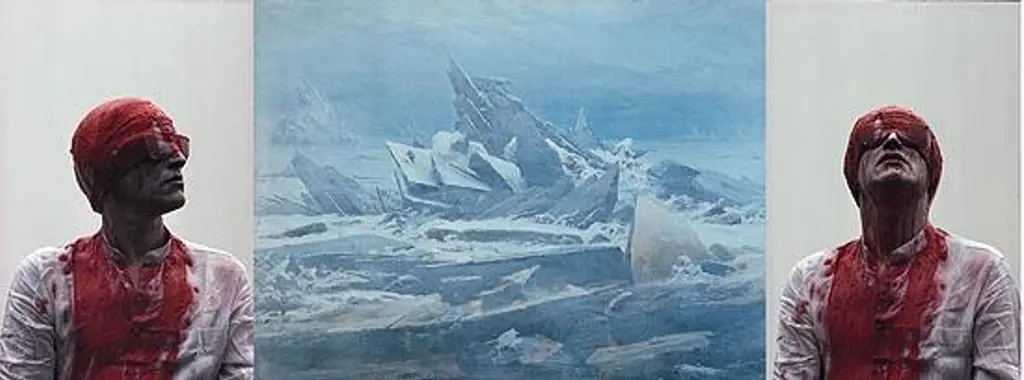
In many self-portraits he appears similarly bandaged, with forklike or tonglike steel interments hocked over his eyelids or into his mouth. In some pictures he reacts to these appurtenances as if they were torture devices. In others he wears them with the air of a compliant patient.
Helnwein not only acknowledges that the self-display his work entails, he even admits to a strategic interest in celebrity. His show winkingly included huge close-up photo portraits of Andy Warhol, William S. Burroughs, Charles Bukowski, Keith Richards, Arno Breker (Hitler's favorite sculptor), and other notables.
In his painted-photo triptych called The Silent Glow of the Avante-Garde (1986), Helnwein abutted two images, which show him bandaged, bloodied, and becalmed, to a reproduction of an icon of German pictorial Romanticism, Casper David Friedrich's shipwreck scene Sea of Ice (ca. 1833-35).