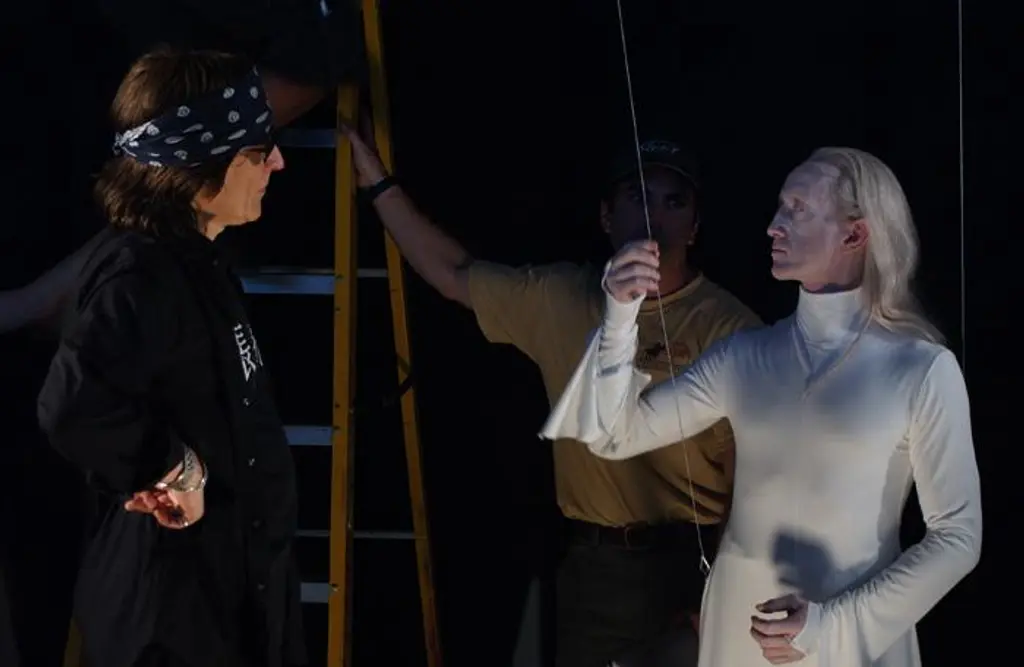
An artist at the zenith of his career—his appointment as Kammertänzer [dancer-laureate] in October 1999 represents but a further highlight in a biography that reads like a dancer's wish list: in 1986, while still a student of Prof. Martin Puttke at the Berlin State Ballet School, he won the Prix de Lausanne d'Or, one of the most coveted prizes for young dance students. After graduation, he proceeded directly to a solo engagement at the Comic Opera in Berlin—a great exception even in GDR times, since the prevailing rule for recent graduates strictly called for them to put in their years of service in the corp de ballet before they could turn to solo work. Here, Seyffert encountered the founder of the GDR dance-theater, the choreographer Tom Schilling. The latter worked out with him a multifarious repertoire of diverse roles, in which Seyffert continues to this day to enthral his audience with expressive character development and breathtaking technique. His youthfully playful interpretation of Romeo, the humorous Match—a relationship duel on the tennis court—or Sleeping Beauty, in which he sweeps over the stage like a whirlwind as the evil, androgynous Carabosse: Seyffert's multifaceted powers of representation appear to know no bounds. And in abstract roles, as well—in François Raffinot's Au delà, for instance—he shines with his refined, almost acrobatic-like technique, and an extraordinarily powerful, expressive stage presence.Outside the opera, Gregor Seyffert works closely together with his father Dietmar, a choreographer and professor for choreography at the Ernst Busch College Berlin. In 1990, the latter created for him the 37-minute solo God's Clown. The piece thematizes the trials and tribulations of the dancer Vaslav Nijinsky, who spent the last 30 years of his life sunk in the fogs of derangement, and shows his desperate struggle against insanity. It lets Seyffert venture far beyond his physical and psychological limits. And the duo Seyffert/Seyffert—together with the company Gregor Seyffert & Compangnie, founded in 1996—has continually had brilliant success with this solo both in Germany and abroad. In 1996, they were invited to represent Germany's cultural contribution at the Olympic Games in Atlanta. In 1997, Gregor Seyffert received the Prix Benois de la Danse/Unesco—the Oscar of dance, which crowned him as the world's best dancer. In October 1999, Berlin Culture Senator Peter Radunski awarded him the title of Kammertänzer—the highest honour that can be bestowed on a dancer in Germany.Gregor Seyffert's expressiveness, his readiness to push his physical and emotional boundaries, his ability to meld into the role, and the extraordinary vividness with which he embodies his characters are all essential components of his artistic quality, and make him one of the most outstanding dancers of his generation.