The Denver Art Museum
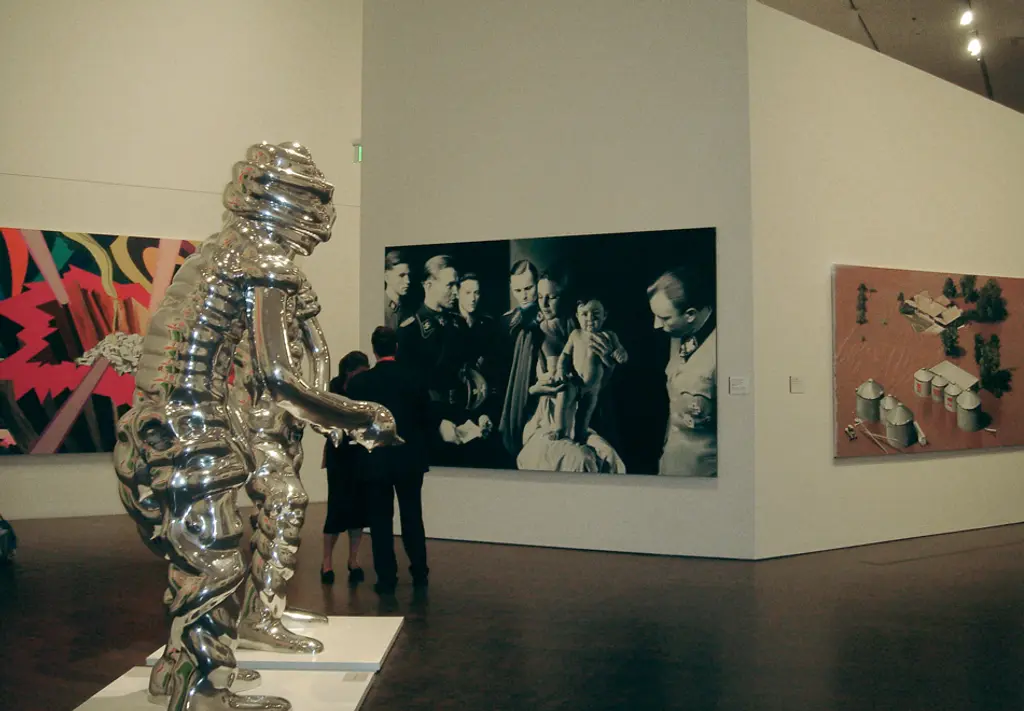
at the 'Radar' exhibition, Denver Art Museum
The exhibition opened with the new Daniel Liebeskind-designed museum wing in autumn of 2006
Epiphany I (Adoration of the Magi)
Denver Art Museum
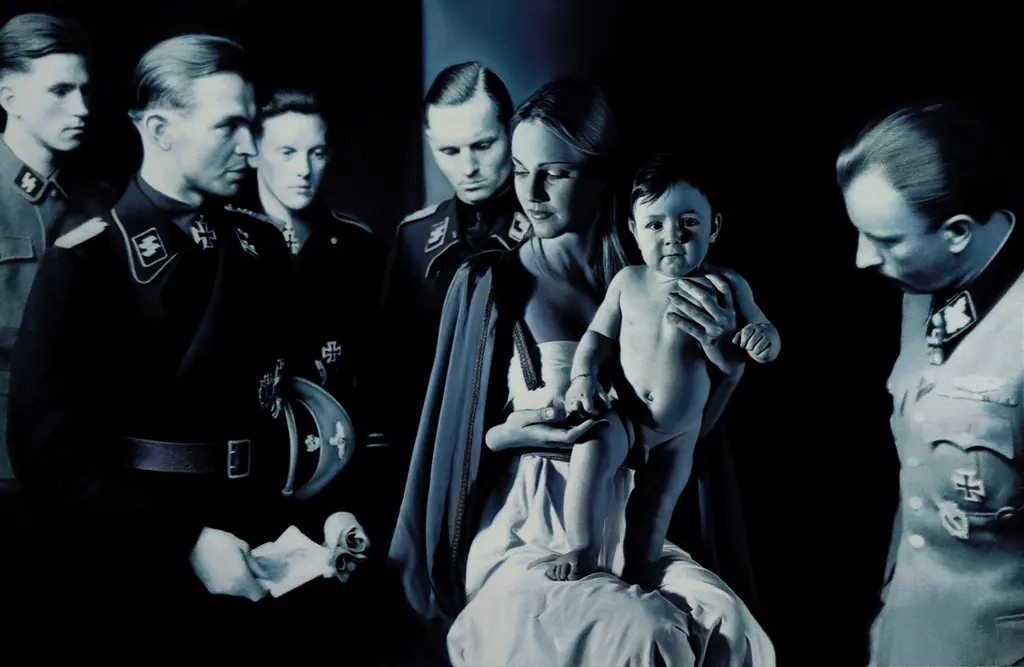
GOTTFRIED HELNWEIN, EPIPHANY (ADORATION OF THE MAGI), 1996
Denver Art MuseumRadar, Selections from the Collection of Vicki and Kent LoganGwen F. ChanzitCurator and professor, Art and Art History, University of Denver
Gottfried Helnwein's Epiphany (Adoration of the Magi) is a strange takeoff on a traditional New Testament theme in art. The work depicts a Madonnalike mother displaying her baby to attentive Nazi officers, Painted in hyperrealist grisaille with chiaroscuro effects, the work resembles an old documentary photograph made huge. The eerie, sinister overtones are unmistakable. Who is this mother? What do these officers want with her and her child? What kind of official paper might the officer on the left hold in his hand and what might be its result? Helnwein, characteristically, presents us with an ambiguous, haunting image and leaves us to wonder about its meaning. Helnwein's background perhaps helps explain why his often difficult subjects have been interpreted in various, often contradictory, ways by opposing sides of the political debate about World War II. With its huge size, hyperrealist style, and disturbing content, this unsettling work bestows a psychological anxiety accompanied by a strong magnetic pull. Confronting it, we tend to stare-entranced by both its beauty and its seductive, malevolent overtones...
Exhibition catalogue, Gottfried Helnwein:
pages: 18, 100, 101, 192
Plate 19
Epiphany (Adoration of the Magi), — 82 _ x 131 inches
Other texts referring to "Epiphany I" by Gottfried Helnwein:
NAZI DREAMING
Julia PascalNew Statesman, UK10. April 2006
Gottfried Helnwein's latest exhibition, "Face It", is the artist's first show in his native Austria since 1985. A retrospective of 40 works from the 1970s to the present, it is more shocking than the Royal Academy's infamous "Sensation" of 1997. Helnwein aims to disturb not with, say, an elephant-dung Madonna, as Chris Ofili did then, but with a far more controversial Virgin.
Of all his paintings, the most disturbing is Epiphany (1996), for which he dips into our collective memory of Christianity's most famous birth. This Austrian Catholic Nativity scene has no magi bearing gifts. Madonna and child are encircled by five respectful Waffen SS officers palpably in awe of the idealised, kitsch-blonde Virgin. The Christ toddler, who stands on Mary's lap, stares defiantly out of the canvas. Helnwein's baby Jesus is Adolf Hitler.
CUTTING EDGE
Aiden DunneThe Irish Times01. August 2001
In Austrian artist Gottfried Helnwein's Epiphany, Nazi officers in uniform cluster around an Aryan woman, an icy blonde Madonna. She supports a naked infant who, it occurs to you, resembles Adolf Hitler, particularly as it has a precocious moustache. For an Austrian artist to venture into this highly charged terrain, blatantly conflating Christian and Nazi iconography, and doing so with work that had such an ambiguous edge and leaves a lot to our own imaginations, suggests a particularly provocative sensibility. While it is a painting, Epiphany is typical in its almost interchangeable use of photography and painting: both played their part in the achievement of the eventual, quasi-photographic image. He is a fine photographer, and his photographic portraits of Kilkenny children (enlarged to an enormous scale) form one strand of his festival exhibitions. The careful adaptation of existing imagery is another trait, and his references extend back through fine art history as well as history itself - and popular art forms.
Helnwein is a technically proficient, immensely versatile artist who seems to think instinctively on a grand scale, he had systematically broken taboos.
GOTTFRIED HELNWEIN - DARK INSPIRATION
Los Angeles TimesArts & CultureLynell George27. January 2008
Some might think that Los Angeles - its unrelenting sun, its one-step-away-from-reality perch - is an incongruous place for someone like Helnwein. What he creates, regardless the medium - watercolor, oil, photography, performance art, sculpture - is a thorny psychological excursion into our sublimated self, our obscured corners and dark humors.
His explorations into war crimes, Catholicism, disfigurement and the Holocaust are both unflinching and surgical. "Epiphany I (Adoration of a Magi)," a 1996 painting, renders the infant -- interpreted both as Hitler and Christ - as being visited by not three men but five, in S.S. uniforms. His work is in museum collections around the world, including those of LACMA and the Smithsonian, and critics have labeled it grotesque, fearless, disturbing and "veer[ing] dangerously close to offensive." People are surprised, he says, when they discern that he doesn't "seem insane." — The visceral reactions, he's come to realize, have as much to do with what's already in the viewers head as what he's created. "It's not my piece of canvas with tiny fractions of pigment," he explains. "The . . . art . . . has the potential of putting that finger on the spot, and it can trigger something that you'd rather not like to look at. But it's [already] in your own mind. That's what I think art can do."
HELNWEIN EPIPHANY
The Jewish JournalLos AngelesMitchell Waxman23. July 2004
Some of the most powerful images that deal with Nazism and Holocaust themes are by Anselm Kiefer and Helnwein, although, Kiefer’s work differs considerably from Helnwein’s in his concern with the effect of German aggression on the national psyche and the complexities of German cultural heritage. Kiefer is known for evocative and soulful images of barren German landscapes.
But Kiefer and Helnwein’s work are both informed by the personal experience of growing up in a post-war German speaking countries... — William Burroughs said that the American revolution begins in books and music, and political operatives implement the changes after the fact. To this maybe we can add art. And Helnwein's art might have the capacity to instigate change by piercing the veil of political correctness to recapture the primitive gesture inherent in art.
Gottfried Helnwein - THE ART OF HUMANITY
Jonathon KeatsMuseum of Tolerance, Simon Wiesenthal Center, Los AngelesDocumentary "Ninth November Night" , Children and the Holocaust in the Art of Gottfried Helnwein2003
Helnwein's Epiphany paintings, three large canvasses completed in the late '90s, are his most perfect work to date. The pictures each seem deeply familiar, traditional in their iconography, yet they remain persistently resistant to fixed interpretation. For example, Epiphany III (Presentation at the Temple) takes as its structure the anatomy lesson paintings -- spectators gathered around a cadaver -- popular in Holland during the 17th Century. Only these spectators aren't doctors. They appear, for at least some viewers, to be the leaders of the Nazi party (Göring and Goebbels and Hitler), faces mangled and bandaged over. And where there would ordinarily be a dismembered cadaver is a pretty little girl, lying peacefully on a table, the very picture of Aryan perfection, dead or maybe asleep. There are no saws or scalpels, nor is there anywhere an all-knowing Galen. The figures are gathered for no overt purpose, absent of any reason. If we take the men to be Nazis, we can speculate that, perhaps, as happened to Lady Macbeth, their self-mutilated ethics have been brought to the surface, that they're the true subjects of this dissection. Has there, then, been a reversal of roles? Has their underlying evil been exposed by this blameless girl, a stillborn ideal for whom humanity was sacrificed? Maybe. But the picture could as well be perceived as a memorial to the struggle the Nazis endured to foster a new nation, the little girl signifying the purity of their purpose even in the face of their failure.
MADONNA
Günter ZehnderRheinisches Landesmuseum, Bonn1996
Gottfried Helnwein's artistic and intellectual approach is to aim quite subtly at producing a crucial feeling of insecurity and a concomitant change of consciousness in the viewer, by using seemingly familiar or usual images that have a certain amount of tradition and an apparently well known composition.
This method is used to jolting effect in the great "Epiphany" (Adoration of the wise men) 1996. In this work, SS officers surround a mother and child group. To judge by their looks and gestures, they appear to be interested in details such as head, face, back and genitals. The mother and the child group finds its direct models in sculptures like Michelangelo's "Maria with the Child", 1503-05, St. Mary's Church in the town of Brugge, Belgium. The arrangement of the figures clearly relates to motive and iconography of the adoration of the three Magi, such as were common especially in the German, Italian and Dutch 15th century artworks.
HELNWEIN ET LE NAZISME
GOTTFRIED HELNWEIN –UN CRITIQUE DE LA SOCIÉTÉGalia FischerUniversité Paris I. Panthéon-SorbonneMémoire de Maîtrise d’Histoire de l'art2003
J’ai parlé plus haut du choix de Helnwein de ne pas utiliser des vraies photographies documentaires pour évoquer la mémoire du Kristallnacht dans la série Selktion. Epipahnie est le titre d’une série de trois tableaux qu’Helnwein a créé entre 1996 et 1998 à partir de vraies photos documentaires.
Epiphany I- Adoration of the Magi (“ Epiphanie- Adoration des Mages ”,1996, fig, 17) est un tableau grand format, qui présente au centre de la composition, une madone avec enfant, entourée de cinq officiers SS. en uniforme. — Parmi les officiers il s’en trouve un qui est plus important, et qui se tient débout sur la droite de la madone. Il regarde directement la madone et tient dans ses mains un papier, comme s’il allait le délivrer à la madone. La madone, pour sa part, regarde le document en tenant l’enfant au sein.
KILKENNY ARTS FESTIVAL 2001
The Irish TimesAiden Dunne20. August 2001
Helnwein is famously confrontational, and his bold conflations of Nazi and Christian iconography, in Epiphany and other prominently displayed pictures, predictably generated some friction. Yet, in a way, one shouldn't rush to condemn condemnations of, or expressions or resignation about, Helnwein's work, no matter how superficial or uninformed they turn out to be. Because, let's face it, a large part of its effectiveness had to do with its calculated, barbed ambiguity.
The point of the images is that they put it up to you as a viewer. Given that, one potential line of criticism is that they are designed solely to be provocative, like Marcus Harvey's portrait of Myra Hindley. But the abiding strength of Helnwein's work is that provocation is a means rather than an end; it is - however uncomfortable - morally grounded, if not necessarily in a way that will please all observers... — His beautiful photographs of Kilkenny children are, collectively, a recognisable derivative of his work Selection, which implicitly placed the viewer in the position of someone marking children for extermination. Strong stuff.
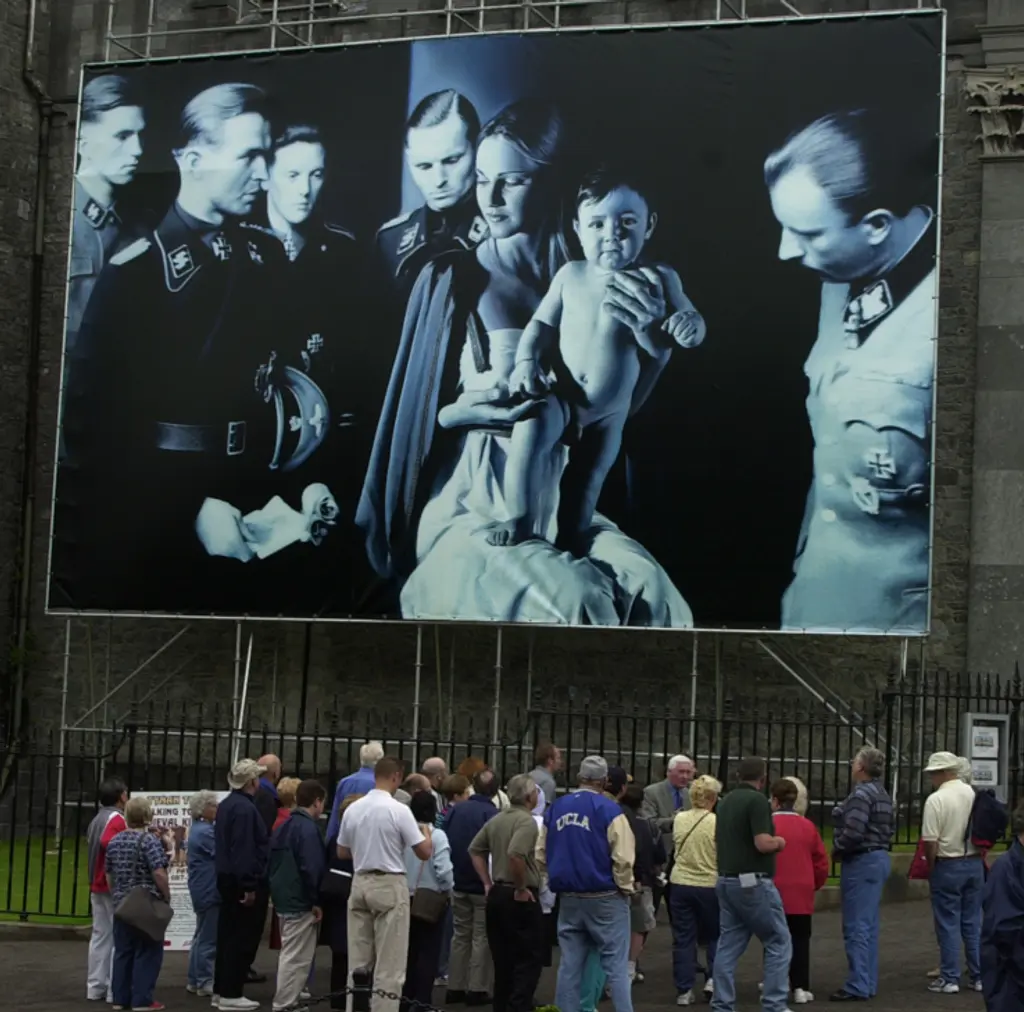
Epiphany I, Adoration of the Magi
HITLER IST BESSER ALS MUTTER MARIA
Gottfried Helnwein : Epiphanie I, Adoration of the MagiSüddeutsche ZeitungReinhard J. Brembeck12. September 1997
"Wir werden eine Zensur dieses Stückes durch NS-Nachfahren nicht hinnehmen." In der Muffathalle brodeln die Emotionen.
Denn die für den kommenden Donnerstag angesetzte Premiere von Heiner Müllers "Hamletmaschine" scheint gefährdet. Weil Gottfried Helnweins Bühnenbild für die Schlußszene einen geradezu absurden Rechtsstreit auszulösen droht. — Denn Ingeborg Wünsche, die Witwe des im Bild "Epiphanie" vorne links stehenden Mannes in Naziuniform mit SS-Runen sowie Totenkopf auf der Mütze, fühlt durch dieses Gemälde Helnweins ihre Persönlichkeitsrechte "im äußersten Maße verletzt". Sie nennt das Bild "Fälschung".
"EIN GUTER MANN"
Abendzeitung,MünchenTim Pröse09. September 1997
Eine Witwe ruft nach Zensur. Mit Gewalt, Hass und der Macht der Diktatur setzt sich die "Hamletmaschine" von Heiner Müller auseinander - so wie auch das Bühnenbild des Wiener Künstlers.
Das passt der Witwe des in schwarzer Totenkopfuniform abgebildeten SS-Mannes nicht. Die Münchnerin Ingeborg Wünsche will das Bühnenbild heute per einstweiliger Verfügung verbieten lassen. Die Muffathallen- Betreiber und deren Anwalt Günter Seefelder aber wollen "bis in die letzte Instanz" gegen die Zensur kämpfen.
HAMLET, HEINER, HOF, HELNWEIN
Münchener Merkur,Kultur.Malve Gradinger13. September 1997
Münchener Muffathallen-Produktion und die Geschichte eines Bildes und einer Witwe. Finis eines gefährlich-absurden post(?)-faschistischen Vorspiels: Ingeborg Wünsche. Witwe eines SS-Mannes, hat von den angedrohten juristischen Schritten gegen Gottfried Helnweins "SS-Gruppenbild mit Madonna und Kind" schließlich abgesehen...
Artists on Art: From Any Angle Logan Lectures 2007 features lectures by ten contemporary artists.
Helnwein: Thursday, December 13th, 2007, 6:30 pm — Written by Ken Hamel
Vicki and Kent Logan
More than 14 years of collecting, Vicki and Kent Logan have amassed a renowned collection of modern and contemporary art and are considered some of the most progressive and active collectors of contemporary art in the world.
In conjunction with the bequest, an immediate donation of $50,000 was made to fund programming related to the opening of the new modern and contemporary galleries in the Museum’s Hamilton Building this fall. Many of the objects from the 2003 donation will be on view in Radar: Selections from the Collection of Kent and Vicki Logan, a temporary exhibition on view at the opening of the Frederic C. Hamilton Building.
“The opening of the Hamilton Building has set the stage to take the Denver Art Museum’s modern and contemporary art program to a whole new level,” said Kent Logan. “Our hope is to have our collection used as a catalyst to expand and enrich the scope of contemporary programming presented on this new stage through insightful in-house curatorial presentation and unique collaborative initiatives with select contemporary art institutions around the world.”
The new Hamilton Building, which will nearly double the size of the Museum, will include more than 17,000 square feet of gallery space and an outdoor sculpture deck dedicated to modern and contemporary art. The third floor atrium space in the modern and contemporary galleries will be named the “Vicki and Kent Logan Modern & Contemporary Atrium Gallery” in recognition of the recent gift.
The Logans credit the Museum’s expansion project, the $61 million dollar endowment commitment by the board of trustees, and added gallery space for contemporary art as the foundation for their continued support of the Museum.
Since 2002, the Museum has had the opportunity to select artwork from the Logans’ private collection for special exhibitions, such as the work displayed in Full Frontal: Contemporary Asian Artists from the Logan Collection that was exhibited in the Museum’s Asian art galleries in late 2003 to early 2004. That exhibition represented artists from China, Singapore, and Taiwan; the paintings and photographs in that exhibition included pieces by Hung Tung-lu, Song Yonghong, Su-en Wong, Yu Youhan, Zeng Fanzhi, and Zhang Huan.
The Logans have helped forge new collaborations within the Denver community including a partnership between the Logans, the Museum and the University of Denver. In 2003, this relationship enabled students at DU to utilize the Logan material for study and education, including exhibitions organized by students and shown at the University of Denver’s Victoria H. Myhren Gallery in 2004.
Kent Logan, a retired investment banker, and his wife Vicki moved their permanent residence to Vail in early 2000 after spending 10 years in San Francisco, where their passion for collecting contemporary art flourished.
The Logans are regularly named in ARTNews’ list of top 200 art collectors. Kent Logan sits on the board of the Clyfford Still Museum in Denver and the Aspen Art Museum. In addition, Vicki is also a trustee of the San Francisco Museum of Modern Art.
Full statement from Kent Logan:
“I have always felt that personal relationships play a major role in any important achievement, and this was certainly the case with our gifts to the DAM. Vicki and I cannot express how important Lewis Sharp and Dianne Vanderlip have been in our decision. Having met many museum directors and curators over the past decade, there are none that I hold in higher esteem for their knowledge, professionalism and sincerity. The opening of the Hamilton Building has set the stage to take the Denver Art Museum’s modern and contemporary art program to a whole new level; our hope is to have our collection used as a catalyst to expand and enrich the scope of contemporary programming presented on this new stage through insightful in-house curatorial presentation and forging unique collaborative initiatives with select contemporary art institutions around the world.”
The Denver Art Museum
is located in downtown Denver on 13th Avenue between Broadway and Bannock. The Museum is open Tuesday through Saturday 10 a.m. to 5 p.m.; Wednesday 10 a.m. to 9 p.m.; Sunday noon to 5 p.m.; closed Mondays and most major holidays. The Museum is open late on Wednesdays. Through Sunday, April 2, general Museum admission is free for children 12 and under and Museum members, $6 for seniors 65+, students 13 and older and college students with I.D., $8 for adults. General admission is free for Colorado residents every Saturday, thanks to the citizens who support the Scientific and Cultural Facilities District (SCFD). Beginning Tuesday, April 4, general Museum admission is free. The Cultural Complex Garage is open; enter from Broadway between 13th and 12th Avenues. Additional parking lots and meters surround the Museum. Or take the bus: call RTD at 303-299-6000 for more information. Adaptive/interpretive services are available with one week’s notice by calling 720-865-5170; TTY 720-865-5003. For more information, call 720-865-5000 or visit the Museum’s website at www.denverartmuseum.org. For information in Spanish, call 720-913-0169.
RADAR, The Logan Collection, Denver Art Museum, 2006
ISBN 0-914-738-53-4
All rights reserved. No part of the contents of this book may be reproduced, stored in a retrieval system, or transmitted in any form or by any means, electronic, mechanical, photocopying, recording, or otherwise, without the prior written permission of the Denver Art Museum.
Copyright 2006 Denver Art Museum
100 W. 14th Ave. Pkwy, Denver, CO 80204
Imprint:
Published on the Occasion of the exhibitionRADAR: Selections from the Collection of Vicki and Kent LoganOctober 7, 2006- July 15, 2007Denver Art MuseumCurated by Dianne Perry VanderlipThe Polly and Mark Addison Curator of Modern and Contemporary ArtFunding for this exhibition generously provided by JPMorganChaseDesigned by Aufuldish & WarinnerEdited by Laura CarusoProduction coordinated by Sue Medlicott and Nerissa Dominguez ValesPrinted in Italy by TrifolioBound in Germany by Real LachenmaierNote to the reader: The preferred order and spelling of each artist's name has been respected. All photos are reproduced with the permission of the artists or their representatives.ISBN 0-914-738-53-4Page 192:Gottfried HelnweinAustrian, born 1948, Vienna, Austria;Lives in Los Angeles and IrelandEpiphany (Adoration of the Magi), 1996Oil and acrylic on canvas82 _ x 131 inches\Collection of Vicki and Kent Logan; fractional and promised gift to the Denver Art Museum, 2001.741Helnwein picture on pages: 10, 12